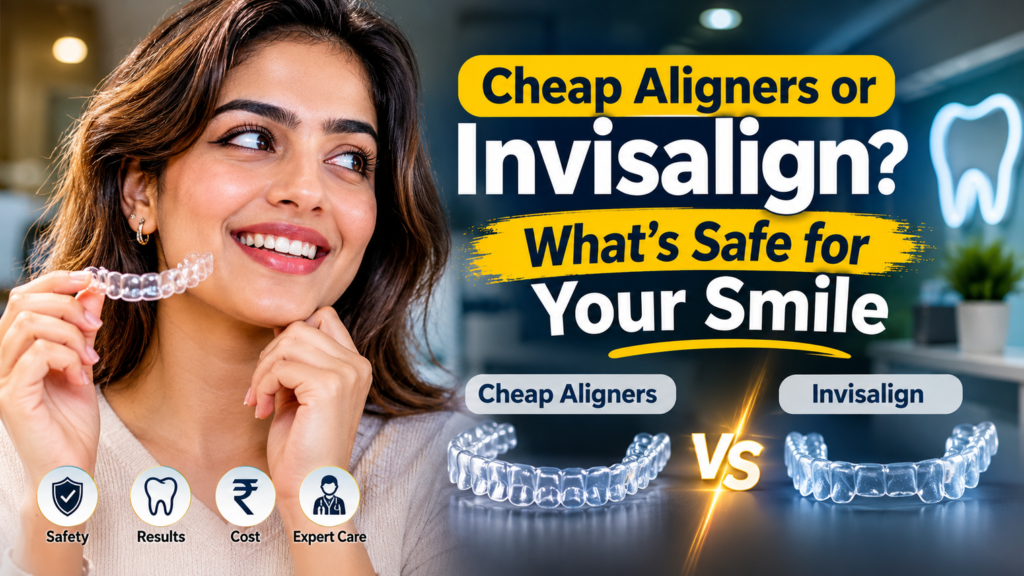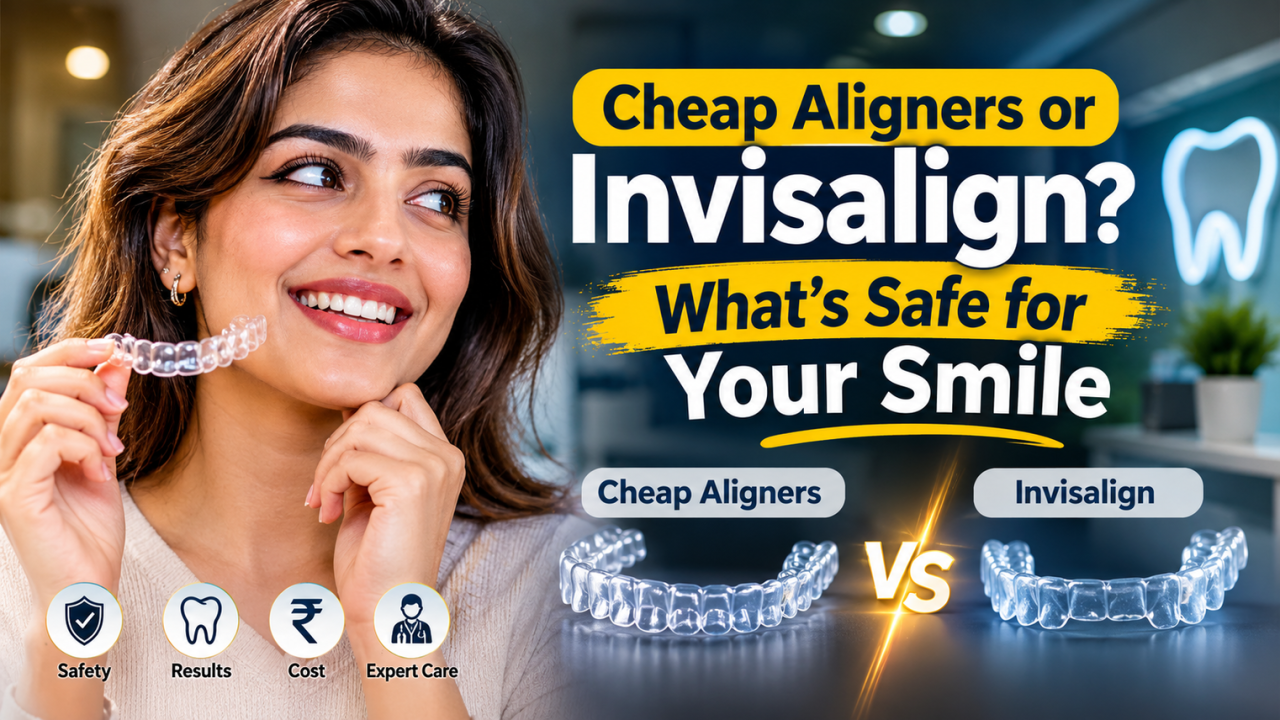
Are you thinking about straightening your teeth without braces?
Before choosing inexpensive online aligners, or investing in invisalign, understand what matters most: dental health, treatment accuracy.
Also include professional supervision and long-term stability.
At Krisshnaa Dental & Multispeciality Care, we believe choosing clear aligners begins with an assessment of teeth, gums, and bite.
Moreover, it should not be based solely on price.
Online aligner brands often advertise straighter teeth at a lower cost.
However, Invisalign offers a different approach.
It uses a series of custom-made clear aligners within a treatment plan developed and monitored by a dental professional.
Other dentist-supervised aligner systems may also be suitable, depending on the individual case.
However, the important question is not simply which aligner costs less. The focus is whether the treatment suits your teeth and whether clinicians monitor your progress properly with invisalign.
If you are looking for Invisalign or clear aligners in Delhi, this guide explains the differences and potential risks.
Additionally, it covers costs and the questions to ask before starting treatment.
Quick Answer: Is Invisalign Safer Than Cheap Online Aligners?
Clinicians supervise Invisalign treatment and provide professional assessment, individualized treatment planning, and progress monitoring. Some online aligner services may offer less in-person supervision, though care levels vary between providers.
Neither the brand name nor the price alone guarantees a safe outcome.
First, ensure a qualified dental professional assesses your oral health and whether your teeth can be moved safely.
Next, confirm they explain how complications or unexpected tooth movements will be managed.
Our recommendation is to compare the quality of clinical supervision and the treatment’s suitability.
Also, assess the ongoing support, including invisalign, rather than choosing solely on price.
1. What Are Clear Aligners, and How Do They Straighten Teeth?
Clear aligners are removable, transparent trays designed to move teeth gradually into planned positions. Each set applies controlled forces to the teeth, with successive trays guiding the treatment towards its intended result.
Clear aligners may be used to treat selected cases involving:
- Crooked or misaligned teeth
- Gaps between teeth
- Mild to moderate dental crowding
- Certain bite irregularities
- Some orthodontic problems that affect the appearance of a smile
However, not every orthodontic problem can be treated effectively with aligners alone. Severe crowding, complex bite problems, impacted teeth, and some jaw discrepancies may require alternative or additional treatment.
How does clear aligner treatment work?
Step 1: Dental examination
Your dentist examines your teeth, gums, bite, and existing dental work. X-rays are recommended when clinically indicated to assess factors that cannot be evaluated adequately through photographs or surface scans alone.
Step 2: Digital scanning
A digital scan or another suitable impression technique records the shape and position of your teeth. This information helps create a three-dimensional model for treatment planning.
Step 3: Personalized treatment planning
The clinician determines which teeth need to move, the direction and extent of the planned movements, and whether attachments, space creation, or other procedures may be necessary.
Step 4: Wearing the aligners
You receive a series of custom-made trays. Many treatment plans require approximately 20 to 22 hours of daily wear, although the exact instructions depend on the prescribed system and your clinician’s advice.
Step 5: Progress monitoring
Your dentist checks whether the teeth are tracking as planned. If they are not, the treatment plan may need modification or additional aligners.
Step 6: Retainers
Once active treatment is complete, retainers help maintain the new tooth positions. Teeth can shift over time without appropriate retention.
This process is important whether you choose Invisalign or another professionally supervised clear aligner system.
2. Invisalign vs Cheap Online Aligners: What Is the Real Difference?
Both options may involve transparent trays, but the treatment process behind those trays can be very different.
| Feature | Invisalign with Dental Supervision | Online or At-Home Aligners |
|---|---|---|
| Initial assessment | Clinical examination by a dental professional | May rely heavily on remote screening, depending on the provider |
| Records | Digital scans, photographs and X-rays when indicated | At-home impressions, photographs or remote scanning, depending on the service |
| Treatment planning | Clinician-directed planning using the available clinical records | May involve remote clinician review and varying levels of individualisation |
| Monitoring | Scheduled reviews, which may include in-person appointments | Remote reviews or in-person appointments, depending on the provider |
| Complex tooth movements | May be appropriate for selected cases after assessment | Suitability depends on the system and the level of clinical supervision |
| Attachments and other procedures | May be incorporated when clinically appropriate | Availability and clinical arrangements vary |
| Treatment adjustments | Clinician can assess tracking problems and modify the plan | Arrangements for refinements and corrective treatment vary |
| Retention after treatment | Retainers and follow-up can be incorporated into care | Retainers and follow-up may be included or charged separately |
| Cost | Depends on complexity, duration and the treatment package | Often marketed at a lower initial price, but inclusions vary |
The key difference is the complete treatment pathway, not simply the plastic tray.
A properly supervised alternative aligner system may be appropriate for some patients. Conversely, Invisalign is not automatically the best option for every patient. The right choice depends on the diagnosis, the movements required, and the clinician’s ability to deliver and monitor the treatment.
3. Are Cheap Online Aligners Safe?
They may be suitable for selected patients when the treatment is properly planned and supervised. However, a low-cost program that does not adequately assess or monitor your oral health can expose you to avoidable risks.
Moving teeth is a biological process. The roots, surrounding bone, gums, and bite all matter. A digital simulation showing straighter teeth does not, by itself, establish that the planned movements are clinically appropriate.
Potential risks of poorly planned aligner treatment
1. Gum recession
If tooth movement is unsuitable for the condition of the gums or the supporting bone, periodontal problems may develop or worsen. Gum recession has several possible causes, and aligners are not the only factor that can contribute to it.
2. Root resorption
Orthodontic tooth movement can sometimes cause shortening of the tooth roots. The risk varies between individuals and treatment circumstances. Appropriate assessment and monitoring help clinicians identify and manage concerns.
3. Bite problems
Your teeth may look straighter without fitting together properly. An inadequate treatment plan can leave some teeth contacting prematurely or create unwanted changes in the bite.
4. Worsening dental disease
Existing cavities, gum disease, or other untreated oral health problems may complicate orthodontic treatment. These conditions should be assessed and addressed as appropriate before treatment begins.
5. Poor tracking
Sometimes the teeth do not move as predicted. If the aligners no longer fit properly and the problem is not identified, treatment may become less effective or require additional correction.
6. Relapse after treatment
Teeth can move back towards their previous positions after orthodontic treatment. Retainers and appropriate follow-up are essential for maintaining the result.
7. Additional treatment expenses
If the initial plan is unsuitable or the outcome is incomplete, you may need refinements, a new treatment plan, or further orthodontic care. These expenses can reduce the apparent savings of a low-cost option.
These complications are not inevitable, and they do not occur with every online aligner program. The concern is inadequate assessment, unsuitable treatment, or insufficient monitoring.
4. Why a Dental Examination Matters Before Straightening Your Teeth
A photograph of your smile can show visible crowding or gaps, but it cannot reveal every factor affecting your treatment.
Before recommending aligners, your dentist should consider:
- The health of your teeth and existing fillings or crowns
- Gum health and signs of periodontal disease
- The position of the tooth roots and supporting bone, where assessment is indicated
- Your bite and the relationship between your upper and lower teeth
- The severity of crowding and the space available for tooth movement
- Whether attachments, interproximal reduction or other procedures may be needed
- Your ability to wear aligners as prescribed and maintain oral hygiene
X-rays are not necessarily required in every identical combination or at every appointment. Your dentist should recommend appropriate imaging based on your history, clinical findings, and the proposed treatment.
For example, a patient with mild spacing and healthy gums may have different treatment needs from someone with substantial crowding, existing gum disease, or a complex bite problem.
A safe treatment plan starts with understanding the individual patient, not selecting an aligner package first and trying to fit the patient into it.
5. Invisalign Cost in Delhi vs Online Clear Aligner Prices
Price is understandably one of the first things patients compare when researching clear aligners in Delhi.
Online aligners may advertise lower starting prices than clinic-based Invisalign treatment. However, these figures are not always directly comparable because the services included can differ.
The total cost of orthodontic treatment may depend on:
- The severity of crowding, spacing or bite problems
- The number of aligners required
- The complexity and duration of treatment
- The clinical records and investigations needed
- Whether attachments or additional procedures are required
- The number of refinements included
- The cost of retainers after treatment
- The number and type of follow-up appointments
- The need for additional treatment if the teeth do not move as planned
What should you expect to pay?
There is no single reliable price for every Invisalign or clear aligner case in Delhi.
A mild case involving limited tooth movement may have different costs from comprehensive orthodontic treatment involving complex tooth movements or bite correction. Prices also differ between providers and treatment packages.
Rather than relying on a generic online estimate, request a written quotation after a clinical assessment.
Seven questions to ask before paying for aligners
- Is the initial dental examination included?
- Are digital scans, photographs and clinically indicated X-rays included?
- Who is responsible for planning and supervising the treatment?
- How often will my progress be reviewed?
- Are refinement aligners included if my teeth do not track as planned?
- Are retainers included in the quoted price?
- What happens if the treatment needs to be changed or stopped?
These questions help you compare the actual value of two treatment options instead of comparing their advertised starting prices.
Can you get affordable Invisalign treatment in Delhi?
Affordability should mean understanding the complete cost of treatment and receiving appropriate care within your budget.
Ask your dental clinic whether payment plans or EMI facilities are available. Confirm the applicable terms, any interest or processing charges, and exactly which services are included.
Do not assume that every provider offers no-cost EMI or that a low initial payment represents the full treatment cost.
At Krisshnaa Dental & Multispeciality Care, you can discuss your orthodontic concerns and ask about suitable treatment options and their costs during a consultation.
6. Is Invisalign Better Than Braces?
Invisalign and traditional braces can both straighten teeth, but they work differently and may suit different clinical situations.
| Consideration | Invisalign | Traditional Braces |
|---|---|---|
| Appearance | Clear, removable trays | Brackets and wires are visible to varying degrees |
| Removability | Removed for eating, drinking beverages other than water, and oral hygiene | Remain attached during treatment |
| Discipline | Requires consistent daily wear | Does not depend on remembering to insert trays |
| Oral hygiene | Teeth can be brushed and flossed without the aligners | Cleaning around brackets and wires requires additional care |
| Food restrictions | Aligners are removed for meals | Some hard or sticky foods may need to be avoided |
| Clinical suitability | Suitable for many, but not all, orthodontic cases | Can be suitable for a wide range of orthodontic problems |
| Maintenance | Aligners must be cleaned and stored properly | Brackets and wires require cleaning and professional adjustments |
Neither option is universally superior.
Invisalign may appeal to patients who value a discreet appearance and want removable aligners. Braces may be more appropriate in certain complex cases or when removable appliances are unlikely to be worn consistently.
Your orthodontic needs, daily habits, and clinical examination should guide the decision.
7. Who Is a Good Candidate for Invisalign?
Invisalign may be worth considering if you:
- Want to correct visible crowding or gaps
- Prefer a less noticeable alternative to conventional braces
- Can wear removable aligners for the prescribed number of hours
- Are willing to attend scheduled progress reviews
- Have healthy teeth and gums, or are prepared to address existing problems before treatment
- Understand that retainers will usually be needed after treatment
However, some patients require more complex orthodontic treatment or additional procedures.
A clinical assessment is particularly important if you have significant crowding, a substantial bite discrepancy, gum disease, loose teeth, impacted teeth, or extensive existing dental work.
Children and teenagers may also be candidates for selected aligner treatments, but their dental development and individual needs must be assessed.
You do not need to decide on Invisalign before your consultation. The purpose of the assessment is to establish which treatment is appropriate for you.
8. Clear Aligner Treatment at Krisshnaa Dental & Multispeciality Care, Central Delhi
At Krisshnaa Dental & Multispeciality Care, our approach to smile improvement begins with understanding the patient’s concerns and dental health.
If you are considering Invisalign or another clear aligner option, a consultation can help establish whether removable aligners are suitable for your teeth and bite.
Your assessment may involve the following steps, depending on your clinical needs.
Step 1: Discuss your smile goals
Tell your dentist what you would like to improve, whether that means correcting crowded front teeth, closing gaps, improving alignment, or exploring alternatives to conventional braces.
Step 2: Assess your oral health
Your teeth, gums, bite, and existing dental work are evaluated. Any underlying problems that could affect treatment need to be considered.
Step 3: Explore appropriate treatment options
Based on your assessment, discuss whether clear aligners, Invisalign, conventional braces, or another approach may be suitable.
Step 4: Understand the treatment plan
Ask about the expected treatment stages, daily wear requirements, appointments, possible limitations, and the factors that could affect the final result.
Step 5: Review the complete cost
Understand the proposed fees, what is included, and whether additional aligners, retainers, or other procedures may involve extra costs.
Step 6: Plan for long-term retention
Straightening your teeth is only part of the process. A suitable retainer plan helps maintain your results after active treatment.
Our goal is to help patients make informed decisions about their oral health, appearance, and long-term dental needs.
Visit Krisshnaa Dental & Multispeciality Care in Central Delhi to discuss your smile goals and explore appropriate teeth-straightening options.
Website: https://www.krisshnaadental.com/
Appointments: +91 7836983698 / +91 7836983625
9. Frequently Asked Questions About Invisalign and Clear Aligners
Are cheap online aligners safe?
They may be appropriate for selected cases when supported by proper clinical assessment, treatment planning, and monitoring. However, programs that rely on limited screening or inadequate follow-up may increase the risk of unsuitable tooth movement, bite problems, or missed dental disease.
Check the level of professional supervision before choosing a provider.
Is Invisalign better than other clear aligners?
Invisalign is an established clear aligner system, but it is not automatically the best option for every patient. Other professionally supervised systems may be appropriate depending on the diagnosis, treatment requirements, and clinician’s experience.
The treatment plan and quality of care matter as much as the brand.
How much does Invisalign cost in Delhi?
The cost depends on the complexity of your case, the treatment package, the duration of treatment, and the services included. Ask for a personalized quotation that explains the cost of refinements, retainers, and follow-up care.
A consultation is the best way to obtain a meaningful estimate.
Can online aligners damage your teeth?
Inappropriate or inadequately monitored tooth movement may contribute to complications such as gum problems, root resorption, poor bite relationships, or incomplete correction. Existing cavities or gum disease may also go unnoticed without an appropriate dental examination.
These outcomes are not inevitable, but they are important reasons to seek suitable professional supervision.
How many hours a day should I wear Invisalign?
Many Invisalign treatment plans prescribe approximately 20 to 22 hours of daily wear. The exact instructions depend on your treatment plan. Follow your dentist’s recommendations rather than changing your wear schedule independently.
Can Invisalign fix crowded teeth?
Yes, Invisalign can correct many cases of dental crowding. However, the suitability of treatment depends on the amount of crowding, available space, bite relationships, gum health, and the tooth movements required.
More severe cases may require additional procedures or alternative orthodontic treatment.
Is Invisalign painful?
You may experience temporary pressure, tenderness, or discomfort when starting a new set of aligners. The intensity varies between individuals. Severe, persistent, or worsening pain should be discussed with your dentist.
Can I eat with Invisalign?
Invisalign aligners are generally removed for meals. Water is usually permitted while wearing them, but follow the specific instructions provided for your aligner system. Brush your teeth as advised before reinserting the trays.
Do I need retainers after Invisalign?
Yes, retention is generally necessary after orthodontic treatment. Teeth can shift over time, even after a successful result. Your dentist will recommend a retainer type and wear schedule appropriate for your case.
How long does Invisalign treatment take?
Treatment duration varies according to the complexity of the case, the movements required, and how consistently the aligners are worn. Your dentist can provide an estimate after assessing your teeth. Additional refinements may extend treatment.
Can Invisalign treat severe bite problems?
Some complex bite problems can be treated with Invisalign in selected cases, sometimes in combination with other procedures. Others may be better managed using braces or a different treatment approach. A clinical examination is necessary to determine suitability.
Where can I consult a dentist for Invisalign in Central Delhi?
You can contact Krisshnaa Dental & Multispeciality Care in Central Delhi to discuss your orthodontic concerns and explore appropriate teeth-straightening options.
Website: https://www.krisshnaadental.com/
Phone: +91 7836983698 or +91 7836983625.
The Final Verdict: Choose the Treatment, Not Just the Price
Cheap aligners can look attractive when the advertised price is substantially lower than Invisalign. But the initial cost tells you very little about the suitability of the treatment, the quality of clinical supervision, or the support available if something goes wrong.
Invisalign is not necessary for every patient, and online aligners are not automatically unsafe. What matters is a proper diagnosis, a treatment plan suited to your teeth, appropriate monitoring, and a clear plan for maintaining the result.
Before spending money on aligners, have your teeth and gums assessed, compare the complete treatment costs, and understand what happens if your teeth do not move as expected.
Your smile deserves a treatment plan based on your dental health, not an advertisement promising the lowest price.
For Invisalign and clear aligner consultations in Central Delhi, contact Krisshnaa Dental & Multispeciality Care.
Website: https://www.krisshnaadental.com/
Call: +91 7836983698 / +91 7836983625