Does your tooth hurt when you bite down, chew food, or release your bite? That small moment of pain can be easy to ignore, especially when the tooth feels normal the rest of the time.
But repeated pain while biting is not something you should simply get used to.
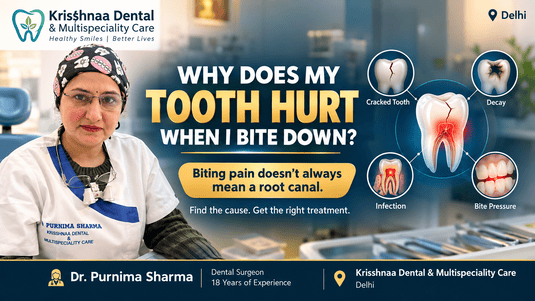
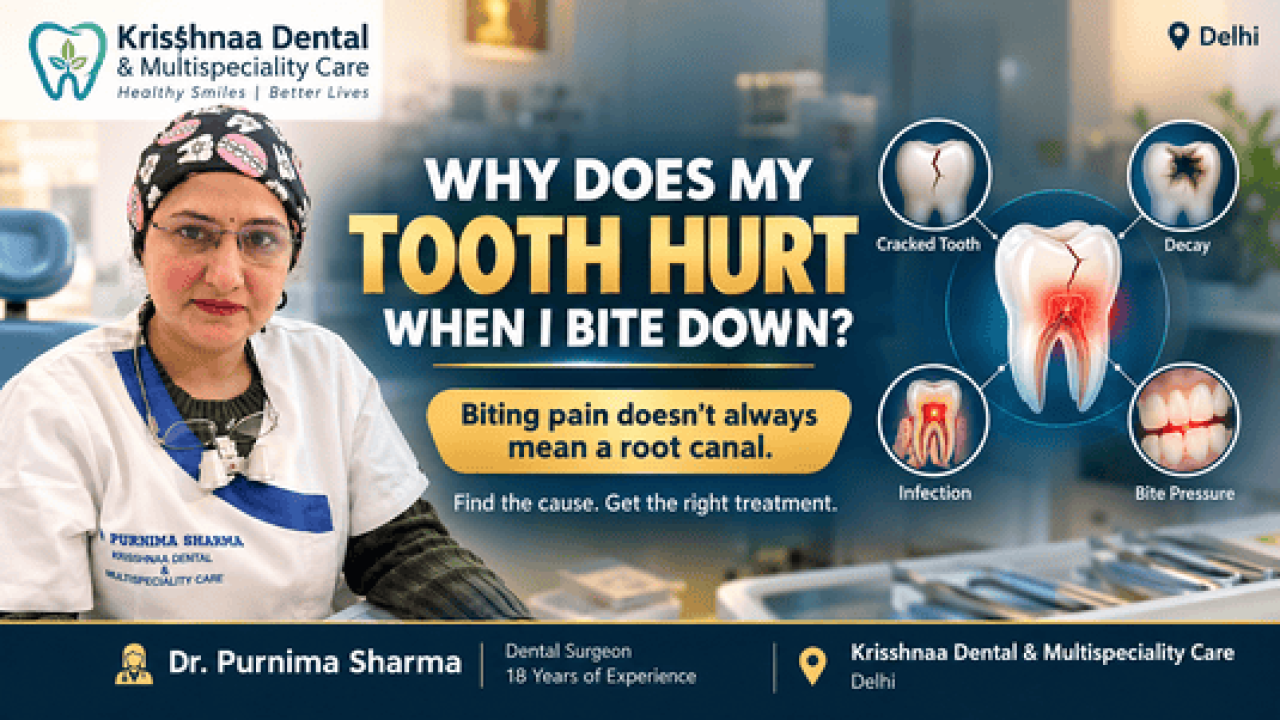
A tooth that hurts when you bite may be affected by tooth decay, a crack, inflammation around the root, excessive biting pressure, gum or supporting-tissue inflammation, or an infection inside the tooth. In some cases, root canal treatment may be required. In others, RCT may not be necessary at all.
At Krisshnaa Dental & Multispeciality Care, Delhi, Dr. Purnima Sharma, an experienced dentist with 18 years of clinical experience, evaluates the pattern of pain, the condition of the tooth and the surrounding tissues before recommending treatment.
The important question is not simply:
“Does my tooth need a root canal?”
It is:
“Why does my tooth hurt when I bite?”
Once the cause is identified, the appropriate treatment becomes much clearer.
Quick Answer: Why Does My Tooth Hurt When I Bite Down?
Pain when biting can have several possible causes.
| Possible Cause | What You May Notice |
|---|---|
| Tooth decay | Sensitivity, pain with pressure or temperature |
| Cracked tooth | Sharp or unpredictable pain, sometimes when releasing the bite |
| Pulp inflammation | Sensitivity, lingering or spontaneous pain |
| Dental infection | Persistent pain, tenderness, swelling or bad taste |
| High bite / excessive pressure | Tooth feels sore or uncomfortable when biting |
| Inflammation around the tooth | Tenderness or pain when pressure is applied |
This is why the intensity of pain alone cannot tell us what is happening. A sharp pain lasting one second may have a very different cause from a tooth that remains sore for hours.
What Does Tooth Pain While Biting Actually Tell Your Dentist?
Dental pain gives us clues, but it does not provide a diagnosis by itself.
Patients commonly describe biting pain as:
- Sharp pain when biting down
- Pain when chewing hard or crunchy foods
- A bruised or sore feeling around one tooth
- Pain that occurs only when pressure is applied
- Pain when releasing the bite
- Pain that comes and goes
- Sensitivity to hot or cold along with biting pain
- A tooth that feels “different” from the surrounding teeth
These details are clinically useful.
For example, pain that occurs when you release your bite may make a dentist consider a cracked tooth as one possibility. However, that symptom alone cannot confirm a crack.
Similarly, a tooth that is tender when biting may have inflammation around its supporting tissues, but the underlying reason could be decay, pulp inflammation, trauma, excessive biting forces or infection.
That is why an experienced dental examination matters.
Could a Cracked Tooth Be Causing Your Biting Pain?
Yes.
A cracked tooth is one of the possibilities considered when a patient reports sudden or inconsistent pain while chewing.
Small cracks can sometimes be difficult to identify during an ordinary visual examination. Some may also be difficult to detect on routine dental X-rays.
You may notice:
- Sudden sharp pain while chewing
- Pain with hard or crunchy foods
- Pain that seems to come and go
- Discomfort when releasing your bite
- Sensitivity to hot or cold
- A particular tooth feeling painful even though it looks normal
However, it is important not to diagnose a cracked tooth simply because you have pain when biting.
The same symptom can occur with several different dental problems.
At Krisshnaa Dental & Multispeciality Care, the objective is to evaluate the complete clinical picture before deciding whether the tooth needs a filling, crown, root canal treatment, monitoring or another form of treatment.
Can a Cavity Cause Pain When You Bite?
Yes.
Tooth decay usually begins in the outer layers of the tooth. If it progresses deeper, it can approach the dental pulp, the living tissue inside the tooth containing nerves and blood vessels.
As decay becomes deeper, symptoms may include:
- Sensitivity to cold or hot foods
- Pain when eating sweets
- Pain while chewing
- Increased sensitivity
- Spontaneous toothache
- Lingering pain after a stimulus is removed
A relatively small cavity may require restorative treatment, while deeper decay involving the pulp may require endodontic treatment.
This is one reason why waiting until a tooth becomes extremely painful is not always a good strategy.
A tooth problem can exist before the pain becomes severe.
When Does Tooth Pain Suggest a Dental Infection?
A dental infection can develop when bacteria reach the inner tissues of a tooth, often through untreated decay, cracks or other damage.
Possible signs include:
- Persistent toothache
- Pain when biting
- Swelling around the tooth
- Tenderness of the gum
- A pimple-like swelling on the gum
- Bad taste in the mouth
- Sensitivity or throbbing pain
- Facial swelling in more advanced cases
A dental abscess is a more serious sign of infection.
Swelling of the face, fever, or difficulty swallowing or breathing requires prompt professional dental or medical attention.
Importantly, not every tooth that hurts is infected.
That distinction matters because the treatment should address the actual cause of the pain rather than simply treating the symptom.
Does Tooth Pain When Biting Mean You Need a Root Canal?
Not necessarily.
This is one of the most important points patients should understand.
Biting pain alone does not automatically mean that root canal treatment is required.
Depending on the diagnosis, the problem could instead be related to:
- Tooth decay
- A cracked or weakened tooth
- A high bite
- Excessive biting pressure
- Inflammation around the tooth
- Gum or supporting-tissue problems
- Dental trauma
- Pulp inflammation
- Infection
Root canal treatment may be considered when the dental pulp becomes irreversibly inflamed or infected and cannot recover on its own.
The purpose of RCT is to remove the diseased pulp tissue, clean and disinfect the root canal system, and seal the tooth so that the natural tooth can potentially be preserved.
So the correct sequence is:
Symptoms → Clinical examination → Diagnosis → Treatment
Not:
Toothache → Root canal
When Might Root Canal Treatment Be Recommended?
A dentist may consider RCT when the examination indicates significant damage or infection of the dental pulp.
Possible situations include:
1. Irreversible pulp inflammation
If the pulp has become severely inflamed and is unlikely to recover, root canal treatment may be recommended.
2. Infection inside the tooth
When bacteria have entered the pulp and infection has developed within the root canal system, endodontic treatment may be required.
3. Deep tooth decay
A cavity that extends deeply into the tooth can affect the pulp and may make RCT necessary.
4. Certain traumatic or cracked teeth
Depending on the location and severity of damage, a tooth affected by trauma or a crack may require root canal treatment as part of its overall management.
5. Preserving the natural tooth
Where appropriate, root canal treatment can allow a diseased tooth to be treated rather than immediately removed.
But every case is different.
A treatment decision should be based on the condition of your particular tooth, not simply on the symptom “pain when biting.”
What If Your Tooth Hurts Only When Chewing?
This is a very common situation.
You may feel completely comfortable when sitting still, but the moment you bite into something hard, one particular tooth hurts.
Because the pain disappears afterward, it can be tempting to ignore it.
You might simply start chewing on the opposite side.
But if the same tooth repeatedly hurts during chewing, it deserves attention.
Try to notice:
- Does it hurt when you bite down?
- Does it hurt when you release the bite?
- Is the pain sharp, dull or throbbing?
- Does the tooth remain sore afterward?
- Is there sensitivity to hot or cold?
- Does the pain occur only with hard foods?
- Is there swelling around the tooth?
- Is the frequency of pain increasing?
These observations can help your dentist understand the problem.
Until the tooth is examined, avoid repeatedly testing it by biting hard objects or deliberately putting pressure on the painful tooth.
Your tooth does not need another stress test to prove that something is wrong.
Why Does a Tooth Hurt When I Bite but Not When I Don’t Touch It?
This pattern can occur because biting places mechanical pressure on the tooth and the tissues surrounding its root.
A tooth may therefore feel normal at rest but become painful when pressure is applied.
Possible explanations include:
- A crack
- Inflammation around the root
- Deep decay
- Pulp-related inflammation
- Excessive bite force
- Trauma
- Problems involving the supporting tissues
This is exactly why a dental examination is more useful than trying to diagnose the problem from the symptom alone.
How Does a Dentist Find the Cause of Biting Pain?
At Krisshnaa Dental & Multispeciality Care, Delhi, the consultation begins with understanding your symptoms.
Dr. Purnima Sharma may want to know:
- When the pain started
- Which tooth you believe is hurting
- Whether the pain occurs while biting or releasing the bite
- Whether hot or cold triggers the pain
- Whether the pain lingers
- Whether you have experienced trauma
- Whether there is swelling
- Whether the pain is becoming more frequent
The tooth and surrounding tissues are then examined.
Depending on the clinical findings, your dentist may recommend dental X-rays or other diagnostic tests.
The purpose is to distinguish between conditions such as:
Decay vs crack vs pulp inflammation vs infection vs bite-related pressure vs supporting-tissue inflammation.
This diagnostic process is important because two teeth can produce very similar symptoms while requiring completely different treatment.
Why Diagnosis Matters Before Root Canal Treatment
Modern dentistry is not simply about treating pain.
It is about identifying why the pain is happening.
For example:
A tooth with a small cavity may need restorative treatment.
A tooth experiencing excessive biting pressure may need a bite evaluation.
A cracked tooth may require careful assessment of the location and extent of the crack.
A tooth with irreversible pulp damage may require root canal treatment.
An infected tooth may require endodontic treatment and appropriate restoration.
The treatment depends on the diagnosis.
That is why an experienced dentist should evaluate the tooth before recommending RCT.
Can Biting Pain Go Away on Its Own?
Sometimes dental pain can temporarily disappear, but that does not necessarily mean the underlying problem has resolved.
Symptoms can fluctuate.
A tooth may hurt one day and feel better the next. You may stop chewing on that side and assume the problem has disappeared.
But if the underlying cause remains, the problem may return or progress.
For this reason, repeated pain from the same tooth should not be ignored simply because it is intermittent.
When Should You See a Dentist for Tooth Pain?
Consider arranging a dental examination if:
- The same tooth repeatedly hurts when you bite
- Pain is becoming more frequent
- You have sensitivity that lingers
- The tooth feels sore after chewing
- You notice swelling
- You have a bad taste or gum swelling
- You have suffered dental trauma
- You suspect a cracked tooth
- Pain is interfering with eating or sleeping
Seek urgent professional attention if there is significant facial swelling, fever, or difficulty swallowing or breathing.
Tooth Hurts When Biting? Don’t Guess the Diagnosis.
If one tooth hurts every time you chew, it is understandable to search online for an answer.
You may see “root canal” immediately.
But a symptom is not a diagnosis.
Tooth pain when biting can have several causes, and each one can require a different approach.
At Krisshnaa Dental & Multispeciality Care in Delhi, Dr. Purnima Sharma brings 18 years of clinical experience to the evaluation of dental problems, with an emphasis on understanding the condition of the tooth before recommending treatment.
Whether the problem is decay, a crack, inflammation, excessive bite pressure or an infection, the first step is to determine what is actually happening.
If your tooth hurts when you bite down, don’t keep guessing.
Book a dental consultation at Krisshnaa Dental & Multispeciality Care, Delhi, and let a dentist identify the cause of your pain and discuss the appropriate treatment options.
Krisshnaa Dental & Multispeciality Care
Delhi | Near Shastri Nagar, Pul Bangash & Kishan Ganj
Call: +91 7836983698 | +91 7836983625
Website: www.krisshnaadental.com
About Dr. Purnima Sharma
Dr. Purnima Sharma is an experienced dental surgeon with 18 years of clinical experience, with a focus on comprehensive dental care, restorative dentistry and aesthetic dental treatment.
At Krisshnaa Dental & Multispeciality Care, she evaluates each patient’s dental concern in the context of their individual oral health rather than assuming that one symptom automatically requires one particular treatment.
Her approach: diagnose first, explain clearly, and then plan the appropriate treatment.