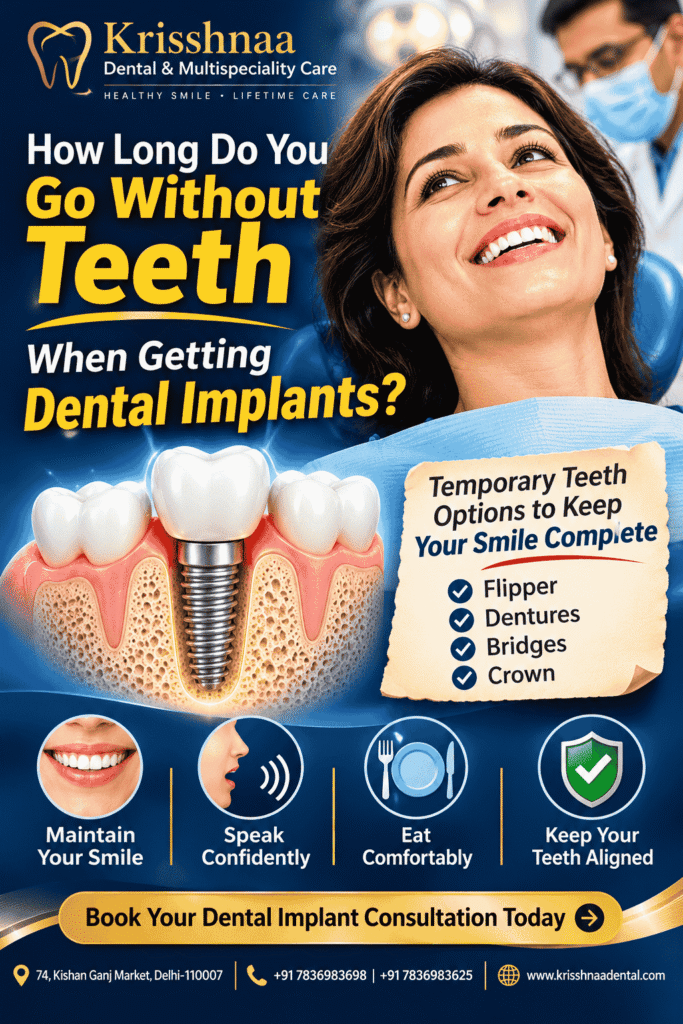
Worried about having no teeth while waiting for dental implants to heal? You are not alone. One of the most common concerns patients have before implant treatment is whether they will need to spend weeks or months with a visible gap in their smile.
The reassuring news is that, in many cases, you do not have to remain without teeth throughout the dental implant healing period. Depending on your oral health, bone condition and treatment plan, your dentist may provide temporary teeth on the same day, shortly after extraction, or during the initial healing phase.
At Krisshnaa Dental & Multispeciality Care, Central Delhi, we plan dental implant treatment with attention to both function and appearance. Our aim is to help patients maintain a comfortable, natural-looking smile while their implants heal.
Let’s understand how long you may be without teeth, what temporary replacement options are available and when you can receive your permanent implant teeth.
How Long Will You Be Without Teeth After Dental Implant Surgery?
There is no single timeline that applies to every patient. The time depends on whether the implant can be placed immediately, whether it can support a temporary tooth safely and whether the extraction site and surrounding bone are healthy.
Here are the possible treatment situations:
1. Same-day temporary teeth: In suitable cases
Some patients can receive temporary teeth on the same day as tooth extraction and implant placement.
This approach may be considered when:
- There is sufficient healthy jawbone.
- The implant achieves adequate initial stability.
- The gums and surrounding tissues are suitable.
- There is no uncontrolled infection or other significant complication.
- The patient can follow the required dietary and aftercare instructions.
However, receiving an implant on the same day does not automatically mean that a temporary crown can also be attached immediately. The dentist must assess whether immediate loading is safe.
2. Temporary teeth after a short healing period
If immediate placement or loading is not advisable, your dentist may recommend allowing the extraction site to heal before proceeding.
During this period, a temporary removable tooth, partial denture or another suitable restoration may be provided.
The exact timing depends on the extraction site, gum healing, bone condition and whether additional procedures such as bone grafting are needed.
3. A longer waiting period in complex cases
Some patients need additional healing time because of:
- Insufficient jawbone volume.
- Bone grafting requirements.
- Gum infection or periodontal disease.
- Complicated tooth extraction.
- Medical or healing-related considerations.
- Multiple missing teeth requiring a more extensive rehabilitation plan.
In these situations, the dentist may recommend a longer healing period before implant placement or before attaching a temporary restoration.
Important: There is no guaranteed 3-day, 7-day or 14-day timeline for everyone. Your dentist can estimate the likely waiting period after examining your mouth and reviewing the treatment plan.
Why Can’t You Always Get Your Permanent Teeth Immediately?
Dental implants are designed to replace missing tooth roots. A small titanium implant is surgically placed inside the jawbone, where it gradually integrates with the surrounding bone.
This healing process is called osseointegration.
During osseointegration, the bone develops a stable connection with the implant. This is essential for supporting the final crown, bridge or full-mouth restoration.
Depending on bone quality, implant stability, surgical requirements and individual healing, this process commonly takes several months.
Attaching a permanent tooth too early may place excessive pressure on an implant that has not achieved sufficient stability.
That is why your dentist may recommend temporary teeth first and the final restoration after adequate healing.
What Temporary Teeth Can You Wear While Dental Implants Heal?
You may have several options for replacing missing teeth during the healing period. The most appropriate choice depends on how many teeth are missing, their location and the type of implant procedure.
1. Dental Flipper
A dental flipper is a lightweight removable temporary appliance designed to replace one or a few missing teeth.
Advantages:
- Helps conceal a visible gap.
- Relatively simple to make.
- Can be removed for cleaning.
- Often useful for replacing a missing front tooth temporarily.
It must be designed carefully so that it does not put unwanted pressure on the surgical area.
2. Temporary Partial Denture
A removable partial denture can replace several missing teeth.
It may be recommended when a patient needs a temporary solution while waiting for implant treatment or healing.
Advantages:
- Replaces multiple missing teeth.
- Helps maintain the appearance of the smile.
- Can be removed for cleaning.
- May provide a practical interim solution.
The dentist must ensure that it does not press against the healing implant or graft site.
3. Temporary Dental Bridge
A temporary bridge may be considered when several teeth are missing in a row.
Depending on the clinical situation, it may be supported by neighbouring natural teeth or designed as part of an implant treatment plan.
A bridge can provide a fixed temporary replacement in selected cases. However, not every patient is suitable for this option.
4. Temporary Crown on a Dental Implant
In carefully selected cases, a temporary crown can be attached to a newly placed dental implant.
This is known as immediate provisionalisation or immediate loading, depending on the treatment protocol.
It can be particularly valuable when replacing a visible front tooth.
The temporary crown is designed to protect the appearance of your smile while avoiding excessive biting forces on the implant during healing.
It is not suitable for every patient and may need to be kept out of direct biting contact.
What Is the Difference Between Immediate Implant Placement and Immediate Loading?
These terms are often confused, but they describe different stages of dental implant treatment.
| Treatment term | What it means |
|---|---|
| Immediate implant placement | The implant is inserted into the jawbone on the same day the tooth is extracted. |
| Immediate loading | A temporary restoration is attached to the implant within a short period, according to the treatment protocol. |
| Delayed implant placement | The extraction site is allowed to heal before the implant is inserted. |
| Delayed loading | The implant is allowed to integrate with the bone before the restoration is attached. |
A patient may receive an implant immediately after extraction but still need to wait before receiving a tooth attached to it.
Understanding this difference helps set realistic expectations before surgery.
Why Are Temporary Teeth Important During Implant Healing?
Temporary teeth are not just about appearance. They can also support your everyday comfort and confidence.
1. Maintain Your Smile
A missing front tooth can affect your confidence in social and professional situations. A suitable temporary restoration helps conceal the gap while treatment progresses.
2. Support Clear Speech
Missing teeth, particularly front teeth, can affect pronunciation. Replacing the visible gap may help you speak more comfortably.
3. Maintain Everyday Comfort
A properly designed temporary restoration can make daily activities more comfortable. However, it is important to follow dietary restrictions and avoid placing excessive pressure on the healing implant.
4. Preserve Space in the Dental Arch
A temporary replacement may help maintain the planned space for the final restoration. Your dentist will also monitor the surrounding teeth and bite during treatment.
5. Help You Adjust to Your Final Smile
Temporary restorations can help patients become familiar with the appearance and feel of their planned replacement teeth before the final prosthesis is delivered.
What Happens During the Dental Implant Healing Period?
Dental implant treatment usually takes place in stages.
Step 1: Dental examination and treatment planning
Your dentist examines your gums, remaining teeth and jawbone. Digital imaging, including CBCT scanning when indicated, may be used to evaluate bone dimensions and plan implant placement.
Step 2: Tooth extraction, if required
If a damaged or non-restorable tooth needs removal, the dentist evaluates whether an implant can be placed immediately or whether the area should heal first.
Step 3: Implant placement
The titanium implant is surgically positioned in the jawbone according to the treatment plan.
Step 4: Temporary tooth replacement
If clinically suitable, a temporary crown, bridge or removable appliance may be provided to maintain appearance and comfort.
Step 5: Osseointegration
The implant heals and integrates with the surrounding bone. During this period, you must follow your dentist’s instructions regarding food, oral hygiene and biting forces.
Step 6: Final crown or bridge placement
After adequate healing and confirmation of implant stability, the final customised crown, bridge or full-mouth restoration is fitted.
Can You Eat Normally With Temporary Teeth?
You can usually continue eating with an appropriately designed temporary restoration, but you may need to modify your diet.
During early healing:
- Choose soft foods.
- Avoid hard, crunchy and sticky foods.
- Do not bite directly into hard foods with a newly placed front temporary crown.
- Avoid chewing excessively on the surgical side.
- Follow your dentist’s specific dietary instructions.
Remember that temporary teeth are not designed to withstand the same biting forces as your final restoration.
Who May Need to Wait Longer Before Receiving Dental Implants?
Certain clinical situations require additional assessment or a modified treatment schedule.
These include:
- Patients with significant bone loss.
- Patients requiring bone grafting or sinus augmentation.
- Patients with active gum disease.
- Patients with uncontrolled diabetes.
- Patients with smoking or tobacco habits.
- Patients with complex full-mouth rehabilitation requirements.
Having one of these conditions does not automatically rule out dental implants. It means that treatment planning and healing considerations become particularly important.
Dental Implants in Central Delhi at Krisshnaa Dental & Multispeciality Care
At Krisshnaa Dental & Multispeciality Care, we understand that patients want more than a replacement tooth. They want to know how the treatment will affect their appearance, eating, speech and everyday life.
Under the guidance of Dr. Suresh Kumar, Senior Dental Implantologist, our implant treatment planning considers bone condition, gum health, implant stability, bite forces and the patient’s long-term restorative needs.
Depending on individual requirements, treatment options may include:
- Single-tooth dental implants.
- Multiple dental implants.
- Immediate implant placement in suitable cases.
- Immediate temporary teeth when clinically appropriate.
- Full-mouth dental implant rehabilitation.
- Bone grafting and advanced implant procedures when indicated.
Our clinic serves patients from Karol Bagh, Kishan Ganj, Shastri Nagar, Pul Bangash, Gulabi Bagh, Patel Nagar and other parts of Central Delhi.
You do not necessarily have to spend months without teeth to get dental implants. With proper planning, a suitable temporary replacement can often help you maintain your smile while the implant heals.
Book a Dental Implant Consultation in Central Delhi
If you are considering dental implants and are worried about going without teeth, schedule a consultation to understand your options.
Our team can assess your dental condition, explain the expected treatment timeline and help determine whether immediate temporary teeth are suitable for you.
Krisshnaa Dental & Multispeciality Care
74, Kishan Ganj Market, Old Rohtak Road, Delhi-110007
Call: +91 7836983698 | +91 7836983625
Website: https://www.krisshnaadental.com/
Frequently Asked Questions About Temporary Teeth During Dental Implant Treatment
1. Will I have to go without teeth after dental implant surgery?
Not necessarily. Many patients can use a temporary crown, bridge, flipper or partial denture during the healing period. The appropriate option depends on the surgical site and implant stability.
2. Can I get temporary teeth on the same day as dental implant surgery?
Yes, in selected cases. Immediate temporary teeth may be possible when the implant has sufficient initial stability and the surrounding bone and gums are suitable. It is not appropriate for every patient.
3. How long does it take for a dental implant to heal?
Implant healing and osseointegration commonly take several months. The exact period varies according to bone quality, implant stability, surgical complexity and individual healing.
4. Can I get an implant immediately after tooth extraction?
Yes. This is called immediate implant placement. It may be possible when the extraction site, surrounding bone and gum condition are suitable.
5. Does immediate implant placement mean I will get a tooth on the same day?
No. Immediate placement means the implant is inserted on the day of extraction. Immediate loading means a temporary restoration is attached soon after implant placement. These are separate decisions.
6. Are temporary implant teeth removable?
It depends on the type of restoration. Flippers and partial dentures are removable, whereas temporary crowns or bridges may be fixed. Your dentist will recommend the appropriate option.
7. Can I eat normally with temporary implant teeth?
You should not assume that temporary teeth can handle normal biting forces. A soft diet is often recommended initially, and hard or crunchy foods should be avoided until your dentist confirms that it is safe.
8. Are temporary teeth as strong as permanent implant crowns?
No. Temporary restorations are designed primarily for appearance and interim function. Permanent crowns and bridges are made for longer-term use and are fitted after adequate implant healing.
9. What if I need a bone graft before dental implants?
If additional bone is needed, your dentist may recommend bone grafting before or during implant placement. This can extend the overall treatment timeline. Temporary teeth may still be possible, depending on the surgical plan.
10. Can patients with diabetes get dental implants?
Many patients with diabetes can receive dental implants when their condition is appropriately managed. Blood glucose control, oral health and healing considerations must be assessed before treatment.
11. Will my temporary front tooth look natural?
A temporary restoration can be customised to blend with your existing teeth in colour, shape and size. The final appearance depends on the restoration, available space and clinical conditions.
12. When will I receive my permanent implant crown?
Your permanent crown is usually fitted after the implant has integrated sufficiently with the jawbone and the dentist confirms that it is stable. The timing is individualised.
Have more questions about dental implants? Visit Krisshnaa Dental & Multispeciality Care in Central Delhi for an implant consultation and an individualised treatment plan.