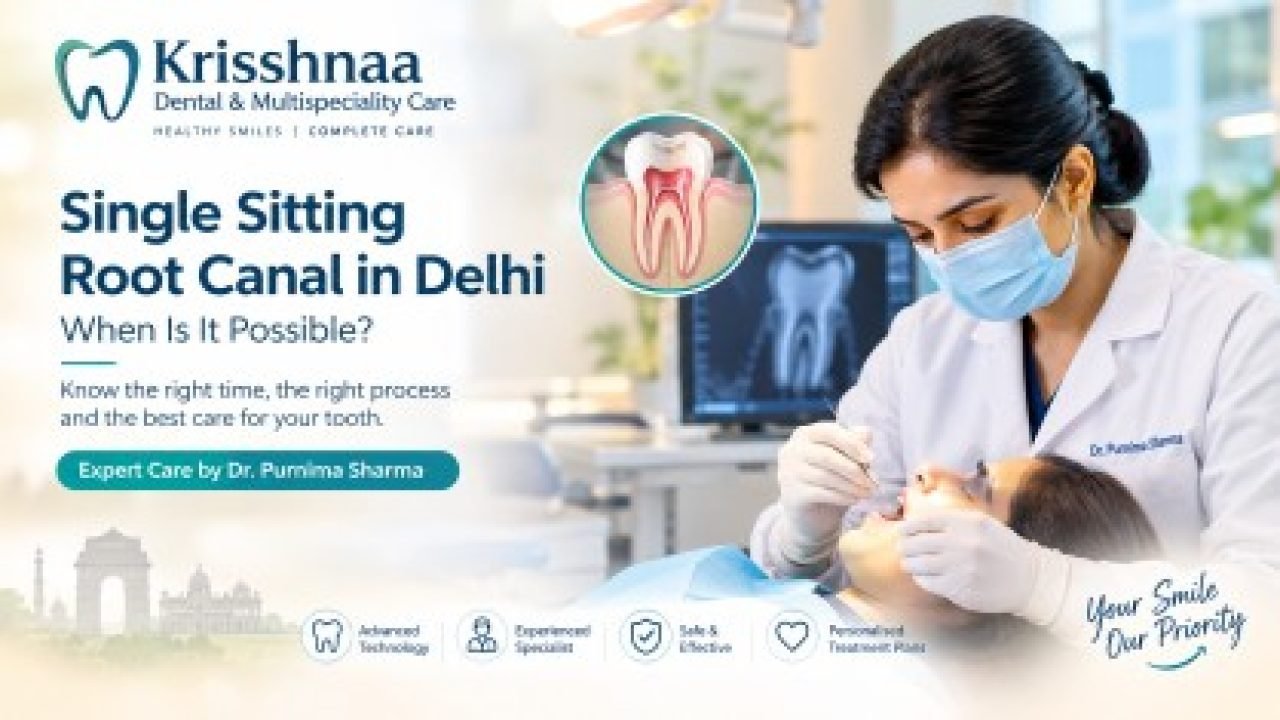
Can a root canal really be completed in one sitting? In many cases, yes. But the more important question is whether your particular tooth is suitable for single-visit root canal treatment.
A single sitting root canal, also called single-visit RCT, means that the dentist aims to complete the essential stages of root canal treatment during one appointment. This generally includes removing infected or inflamed pulp, cleaning and shaping the root canal system, disinfecting it and sealing the canals.
However, one-visit treatment is not a shortcut and it is not appropriate for every tooth.
At Krisshnaa Dental & Multispeciality Care, Delhi, Dr. Purnima Sharma and the dental team assess the tooth, infection, root anatomy, symptoms and restoration requirements before deciding whether treatment can reasonably be completed in one sitting.
The goal is not simply to finish an RCT quickly.
The goal is to treat the infection properly, preserve the natural tooth and restore it so that it can function comfortably for the long term.
Quick Answer: Is Single Sitting Root Canal Possible?
Yes, a root canal can be completed in one appointment in appropriately selected cases.
Whether it is suitable depends on factors such as:
- The condition of the dental pulp
- The extent of infection
- Presence of swelling or an abscess
- Root canal anatomy
- Number and shape of canals
- Condition and restorability of the tooth
- Whether additional procedures are required
- The dentist’s ability to adequately clean, disinfect and seal the canals during the appointment
There is no clinical rule saying that every root canal should be completed in one visit.
Research comparing single-visit and multiple-visit root canal treatment has generally found no clear overall difference in treatment effectiveness, although some evidence suggests that postoperative pain during the first week may be somewhat more common after single-visit treatment in certain groups.
That is why case selection matters more than the number of appointments.
What Is a Single Sitting Root Canal?
A single sitting root canal is an endodontic treatment approach in which the dentist completes the major stages of RCT during one appointment rather than intentionally dividing the treatment over several visits.
The procedure may involve:
- Examination and diagnosis
- Dental imaging
- Local anaesthesia
- Isolation of the tooth
- Accessing the infected pulp chamber
- Removing infected or inflamed pulp tissue
- Cleaning and shaping the root canals
- Irrigating and disinfecting the canal system
- Determining the working length
- Filling and sealing the canals
- Planning the final restoration
Modern endodontic techniques, including rotary or endomotor-assisted instrumentation and electronic apex-locating technology, can help the dentist work more efficiently and accurately when clinically appropriate.
At Krisshnaa Dental & Multispeciality Care, technology is used to support diagnosis and treatment. It does not replace clinical judgment.
Can Every Root Canal Be Done in One Sitting?
No.
This is one of the most important things patients should understand before choosing a dental clinic based only on the phrase “single sitting RCT.”
Some teeth are excellent candidates for one-visit treatment. Others may benefit from treatment divided into more than one appointment.
For example, a dentist may recommend multiple visits when there is:
- Significant infection
- Pronounced swelling
- An abscess or draining sinus
- Complex root canal anatomy
- Difficult-to-access canals
- A need for additional disinfection or medication
- Uncertainty about the tooth’s prognosis
- A requirement for another dental procedure before final restoration
The decision should be made after examining the tooth, rather than promising one sitting before diagnosis.
Who May Be Suitable for Single Sitting RCT?
A patient may be considered for single-visit root canal treatment when the dentist can adequately access, clean, disinfect and seal the root canal system during the same appointment.
Potentially suitable situations may include:
- A tooth with manageable infection
- Root canals that can be adequately accessed
- A tooth that can be isolated properly
- Cases where there is no clinical reason to delay obturation
- Teeth where the dentist can complete the required treatment safely in one appointment
But suitability is individual.
Two patients can have similar tooth pain and still require completely different treatment plans.
This is why Dr. Purnima Sharma focuses on diagnosis before deciding the treatment timeline, rather than treating “one sitting” as a fixed treatment package.
What Happens During a Single Sitting Root Canal?
1. Examination and Diagnosis
The first step is understanding why the tooth hurts and what is happening inside it.
Dr. Purnima may evaluate:
- Your symptoms
- Duration and pattern of pain
- Sensitivity to hot or cold
- Pain while biting
- Previous dental treatment
- Swelling or tenderness
- Tooth structure
- Gum and surrounding tissues
Dental X-rays or other appropriate imaging may be used to evaluate the roots and surrounding bone.
This information helps determine whether the tooth needs RCT and whether a single-visit approach is appropriate.
2. Local Anaesthesia
The tooth is made numb before treatment begins.
Modern root canal treatment is performed with local anaesthesia, and the dental team takes steps to keep the procedure as comfortable as reasonably possible.
If you are anxious about dental treatment, tell the dentist before the procedure. Your concerns can be considered while planning your appointment.
3. Removing the Infected Pulp
Inside the tooth is the dental pulp, which contains nerves and blood vessels.
Deep decay, cracks, trauma or other damage can allow bacteria to affect the pulp.
When the pulp becomes irreversibly inflamed or infected, root canal treatment may be recommended to remove the diseased tissue while retaining the natural tooth.
4. Cleaning and Shaping the Root Canals
This is one of the most important stages of RCT.
The dentist locates the canals and carefully cleans and shapes them so that infected tissue and bacterial contamination can be addressed.
Depending on the case, rotary or endomotor-assisted instruments may be used to improve efficiency during canal preparation.
An electronic apex locator may also assist in determining working length.
The technology is valuable, but the quality of treatment still depends on diagnosis, technique, isolation, irrigation, anatomy and appropriate restoration.
5. Disinfection of the Canal System
Root canals are not simply hollow tubes.
They can have branches, curves, narrow areas and anatomical variations. Effective irrigation and disinfection are therefore important parts of treatment.
The dentist uses appropriate irrigation protocols to help clean areas that mechanical instruments cannot completely contact.
For selected cases, laser-assisted root canal treatment may also be considered as part of the treatment approach.
It is not necessary or appropriate for every patient.
6. Filling and Sealing the Canals
Once the dentist determines that the canals have been adequately cleaned and prepared, they can be filled and sealed.
The purpose of sealing is to reduce the possibility of further bacterial contamination through the treated canal system.
This completes the principal endodontic phase of treatment.
How Long Does a Single Sitting Root Canal Take?
There is no universal time for an RCT.
A straightforward tooth may be treated in one appointment, while a molar with several curved or difficult canals may require considerably more clinical time.
Factors influencing treatment time include:
- Tooth type
- Number of canals
- Root anatomy
- Degree of infection
- Previous treatment
- Calcification
- Access difficulty
- Need for additional procedures
- Restoration requirements
Therefore, patients should be cautious about advertisements promising that every root canal will take exactly a fixed number of minutes.
Good dentistry is not a race against the clock.
Is Single Sitting RCT Safe?
For appropriately selected cases, single-visit root canal treatment is an established treatment approach.
However, no root canal technique can guarantee that a tooth will never experience postoperative pain or future complications.
A 2022 Cochrane review found no evidence of a difference in radiological failure between single-visit and multiple-visit treatment, although the certainty of evidence varied by outcome. The review also found a higher proportion of participants reporting pain within one week in the single-visit groups.
A more recent umbrella review found that higher-confidence systematic reviews did not show a consistent clinically important difference in postoperative pain between single- and multiple-visit approaches, while also noting limitations in the available evidence.
The practical message for patients is simple:
The correct number of visits is the number your tooth needs.
Single Sitting RCT vs Multiple-Visit RCT
Patients often ask:
“Which is better, one sitting or two sittings?”
There is no universal answer.
| Single-Visit RCT | Multiple-Visit RCT |
|---|---|
| Major treatment stages may be completed in one appointment | Treatment is divided over two or more appointments |
| Fewer appointments | More appointments |
| Convenient for busy patients | Allows treatment to be staged when clinically indicated |
| May be suitable for selected cases | May be preferred for certain complex or infected cases |
| Does not guarantee absence of postoperative pain | Does not guarantee absence of postoperative pain |
| Requires adequate cleaning and disinfection before sealing | May allow additional treatment between appointments when indicated |
Evidence does not establish one approach as universally superior. The treatment plan should therefore be based on the condition of the tooth, not simply on the number of appointments.
When Might Multiple Root Canal Visits Be Better?
A second or subsequent appointment is not necessarily a sign that treatment has gone wrong.
Sometimes it is the more appropriate clinical approach.
Your dentist may recommend multiple visits when:
There is significant infection
If the tooth has extensive infection or a complex periapical condition, the dentist may decide that completing treatment immediately is not the best option.
There is substantial swelling
Acute swelling can require additional management before definitive treatment is completed.
The canal anatomy is complex
Curved, narrow, calcified or unusually shaped canals can require additional time and careful management.
Additional medication or disinfection is required
In selected cases, treatment may be staged so that the dentist can reassess the tooth before final canal filling.
The tooth requires additional procedures
Some teeth need periodontal, restorative or surgical considerations as part of the overall treatment plan.
Does Single Sitting RCT Mean Painless Root Canal?
Not necessarily.
“Single sitting” describes the number of treatment visits.
“Painless” describes patient comfort during treatment.
They are not the same thing.
With local anaesthesia and modern techniques, many patients tolerate root canal treatment comfortably. However, some tenderness or discomfort can occur after treatment as the tissues around the tooth settle.
If you have severe or increasing pain, swelling, fever or other concerning symptoms after treatment, contact your dentist promptly.
What Happens After a Single Sitting Root Canal?
Completing the root canal does not always mean the tooth is fully restored.
The next question is:
How should the tooth be protected?
A root canal-treated tooth may need a definitive restoration depending on:
- Which tooth was treated
- How much natural tooth structure remains
- The size of the previous cavity or restoration
- The amount of chewing force
- Whether the tooth has cracks or structural damage
For many heavily damaged posterior teeth, a crown may be recommended to protect the remaining tooth structure.
Do You Need a Crown After Root Canal?
Sometimes, yes.
A crown is not automatically required for every root canal-treated tooth, but it is commonly recommended when substantial tooth structure has been lost or when the tooth is exposed to significant chewing forces.
Dr. Purnima Sharma can assess the remaining tooth structure and discuss whether you need:
- A filling
- An onlay or other restoration
- A dental crown
- Another form of definitive restoration
The restoration should be considered part of the overall treatment plan rather than an unrelated procedure after RCT.
How Long Does It Take to Recover After Root Canal?
Most patients can return to their normal routine according to their dentist’s instructions, but the tooth may feel tender for a period after treatment.
For the early recovery period:
- Follow your dentist’s instructions
- Avoid chewing very hard foods on an inadequately restored tooth
- Maintain normal oral hygiene unless instructed otherwise
- Take prescribed medication only as directed
- Attend the recommended restoration appointment
- Contact the clinic if pain or swelling becomes severe or progressively worse
Remember that root canal treatment removes the infected pulp, but the surrounding tissues may still need time to settle.
Single Sitting Root Canal Cost in Delhi
Patients frequently search for single sitting RCT cost in Delhi, but there is no single price that accurately applies to every tooth.
The final cost may depend on:
- Front tooth, premolar or molar
- Number of canals
- Complexity of canal anatomy
- Severity of infection
- Whether the tooth has been treated previously
- Technology or specialised techniques required
- Need for additional procedures
- Type of final restoration or crown
At Krisshnaa Dental & Multispeciality Care, the appropriate approach is to examine the tooth first and then explain the recommended treatment and associated costs.
Do not choose an RCT solely because it is advertised as the cheapest or fastest option.
A root canal is intended to preserve a natural tooth. The quality of diagnosis, cleaning, disinfection, sealing and final restoration all matter.
Why Consider Krisshnaa Dental & Multispeciality Care for Root Canal Treatment in Delhi?
At Krisshnaa Dental & Multispeciality Care, root canal treatment is planned around the individual tooth rather than a one-size-fits-all package.
Under the clinical guidance of Dr. Purnima Sharma, patients can discuss their symptoms, treatment options and concerns before proceeding.
The clinic’s approach includes modern techniques such as:
- Rotary / endomotor-assisted root canal treatment
- Apex locator-assisted canal length determination
- Single-sitting RCT for appropriately selected cases
- Laser-assisted RCT where clinically indicated
- Restorative planning after root canal treatment
- Dental crowns and aesthetic restorations
- Family and comprehensive dental care
For Dr. Purnima, the important question is not simply:
“Can we finish your root canal today?”
It is:
“Can we complete the treatment properly today, and is that the right approach for your tooth?”
That distinction matters.
Frequently Asked Questions About Single Sitting Root Canal
1. Can a root canal be completed in one day?
Yes, selected teeth can be treated in one appointment. The decision depends on the tooth’s infection, anatomy, restorability and clinical circumstances.
2. Is single sitting RCT better than multiple sitting RCT?
Not universally. Current evidence does not establish one approach as superior for every patient. The appropriate choice depends on the individual tooth and clinical findings.
3. Can an infected tooth be treated in one sitting?
Some infected teeth can be treated in one visit, but significant infection, swelling, complex anatomy or other clinical factors may make multiple visits more appropriate.
4. Is single sitting root canal painful?
The procedure is performed under local anaesthesia. Some postoperative tenderness or pain can occur, and the amount varies between patients and clinical situations.
5. How long does a single sitting RCT take?
Treatment time varies considerably depending on the tooth, number of canals, anatomy and complexity. A molar generally requires more detailed treatment than a straightforward front tooth.
6. Do I need a crown after a single sitting root canal?
Possibly. The need for a crown depends primarily on the amount of remaining tooth structure, tooth position, chewing forces and the overall condition of the tooth.
7. Can a root canal fail?
Root canal treatment is highly established, but no treatment has a 100% guarantee of success. Persistent infection, untreated anatomy, leakage, cracks or other factors can sometimes require further treatment.
8. Can I eat after a single sitting root canal?
Your dentist will tell you when and how to use the treated tooth. Until the final restoration is completed, avoid excessive chewing forces on a vulnerable tooth.
9. Is laser root canal treatment better?
Laser technology may have a role in selected endodontic procedures, but it should not be presented as automatically superior for every patient. The overall treatment plan and appropriate cleaning and disinfection remain important.
10. How do I know if I need a root canal?
Symptoms such as prolonged sensitivity, spontaneous toothache, pain on biting, deep decay, swelling or a dental abscess can indicate the need for evaluation. However, symptoms alone cannot determine whether RCT is required. A dentist needs to examine the tooth and, when appropriate, use dental imaging.
Single Sitting Root Canal in Delhi: The Bottom Line
Yes, a single sitting root canal is possible. But not every tooth should be treated in one sitting.
The right treatment plan depends on the diagnosis.
If your tooth has manageable disease, suitable anatomy and can be adequately cleaned, disinfected and sealed during the appointment, single-visit RCT may be a practical option.
If the tooth has significant infection, swelling, complex anatomy or another clinical concern, your dentist may recommend multiple appointments.
At Krisshnaa Dental & Multispeciality Care, Delhi, Dr. Purnima Sharma and the dental team focus on understanding the condition of the tooth first and then selecting the appropriate treatment approach.
If you have persistent tooth pain, sensitivity, swelling or have already been advised to undergo RCT, an examination can help determine whether you are a candidate for single sitting root canal treatment in Delhi.
Your natural tooth deserves more than a promise of “one sitting.” It deserves the right diagnosis, the right treatment and the right restoration.
Book a root canal consultation at Krisshnaa Dental & Multispeciality Care, Delhi.