Medically guided by Dr. Suresh Kumar Senior Dental Implantologist, Krisshnaa Dental & Multispeciality Care, Delhi | 18+ Years of Clinical Experience
Losing a tooth is not simply a cosmetic problem.
A missing tooth can affect chewing, speech, the position of neighbouring teeth and, over time, the bone that once supported the natural tooth.
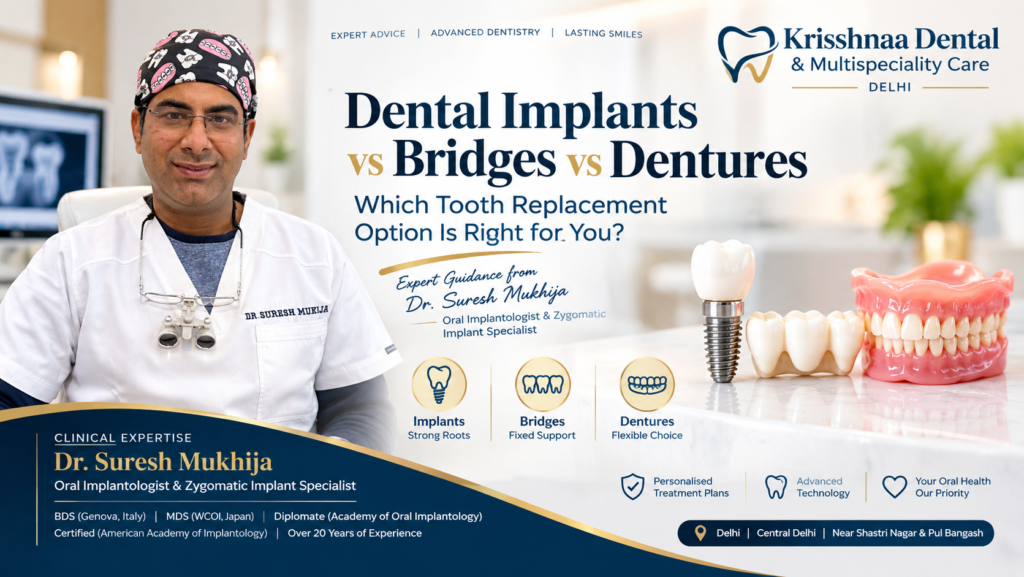
The good news is that modern dentistry offers several ways to replace missing teeth. Dental implants, fixed dental bridges and dentures can all restore the appearance and function of your smile, but they work in very different ways.
So, which one is right for you?
There is no single answer.
As Dr. Purnima Sharma, with more than 18 years of clinical experience, explains, “Tooth replacement should be planned around the patient, not around a particular treatment. We look at the number and location of missing teeth, the condition of the gums and neighbouring teeth, available bone, overall oral health, expectations and long-term goals before recommending an option.”
This guide explains the practical differences between dental implants, bridges and dentures, so you can have a more informed discussion with your dentist.
Key Takeaways
- Dental implants replace both the visible tooth and the tooth-root function with an implant placed in the jawbone.
- Dental bridges replace missing teeth by using neighbouring teeth as support.
- Dentures are removable appliances used to replace several or all missing teeth.
- Implants can help maintain the bone around the missing tooth because they provide an artificial root structure.
- Bridges generally involve less surgical treatment and can provide a fixed replacement without implant surgery.
- Dentures can be useful when several or all teeth are missing, particularly when a removable solution is appropriate.
- The cheapest initial option is not necessarily the most suitable long-term option for every patient.
- Delaying assessment of a missing tooth can allow changes in the teeth, gums and supporting bone.
- The right treatment depends on your individual oral condition, not simply your age or the number of missing teeth.
Dental Implants vs Bridges vs Dentures at a Glance
| Factor | Dental Implants | Dental Bridges | Dentures |
|---|---|---|---|
| How they replace teeth | Implant-supported artificial tooth | Replacement tooth supported by neighbouring teeth | Removable artificial teeth |
| Root replacement | Yes, implant acts as an artificial root | No | No |
| Fixed or removable | Fixed | Fixed | Usually removable |
| Surgery required | Usually yes | Usually no | No implant surgery required |
| Can help maintain bone at missing-tooth site | Yes | No | No |
| Suitable for | One or multiple missing teeth, depending on bone and health | One or several adjacent missing teeth with suitable supporting teeth | Multiple or complete tooth loss |
| Treatment duration | Varies according to bone, healing and restoration | Often comparatively faster | Depends on denture type and individual case |
| Maintenance | Regular professional and home care | Requires careful cleaning around bridge | Regular cleaning and periodic adjustment may be required |
Important: This table is a general guide. Your dentist may recommend a different option after examining your teeth, gums, bone and overall oral health.
1. Dental Implants: Replacing the Tooth and Its Root
A dental implant is designed to replace a missing tooth at the root level as well as the visible crown.
A small implant fixture is placed into the jawbone. After the appropriate healing and integration period, a dental crown, bridge or other restoration can be attached to the implant.
This makes dental implants fundamentally different from conventional bridges and dentures.
Why does the root matter?
Natural tooth roots transmit forces into the surrounding jawbone. When a tooth is lost, that stimulation is reduced and the bone in the area can gradually remodel and shrink.
An implant provides an artificial root structure in the jaw and can help maintain the bone around the implant site.
However, not every missing tooth automatically requires an implant.
Bone volume, gum health, oral hygiene, medical history, smoking habits, the location of the missing tooth and the patient’s treatment expectations all need to be considered.
Who may be considered for dental implants?
Implants may be considered for patients who:
- Have one or more missing teeth
- Have suitable bone volume or may benefit from bone augmentation
- Have reasonably healthy gums or are willing to treat existing gum disease
- Can maintain good oral hygiene
- Want a fixed tooth-replacement option
- Are medically suitable for the proposed procedure
In cases where bone has reduced significantly, additional procedures such as bone grafting or sinus augmentation may sometimes be considered.
This is why an implant consultation should not be based only on a photograph or a price quotation.
A proper clinical examination and appropriate imaging are important for planning.
2. Dental Bridges: A Fixed Alternative Without an Implant
A dental bridge replaces a missing tooth by connecting an artificial tooth to supporting teeth or other suitable structures.
With a conventional bridge, the neighbouring teeth are prepared so that crowns can support the replacement tooth.
For the right patient, a bridge can be a practical way to restore a missing tooth without implant surgery.
Potential advantages of a dental bridge
- Fixed in the mouth
- No implant placement procedure
- Can restore chewing function and appearance
- Treatment can often be completed faster than an implant-based restoration
- May be appropriate when neighbouring teeth already require crowns
What should you consider?
The supporting teeth are an important part of the treatment.
If the neighbouring teeth are weak, heavily restored, affected by gum disease or otherwise unsuitable as supports, a conventional bridge may not be the ideal choice.
Another consideration is the bone underneath the missing tooth. A bridge replaces the visible tooth but does not replace the missing tooth root, so it does not provide the same root-level stimulation to the bone as an implant.
3. Dentures: A Removable Solution for Multiple Missing Teeth
Dentures are removable dental appliances designed to replace several or all missing teeth.
Depending on the clinical situation, a patient may receive:
- Partial dentures
- Complete dentures
- Implant-supported dentures
- Other forms of removable or fixed implant-supported rehabilitation
For patients with extensive tooth loss, dentures can restore important functions such as chewing and speech while also supporting facial appearance.
Why are dentures still relevant?
Not every patient wants or can undergo implant surgery.
Factors such as bone availability, general health, oral condition, finances, treatment preferences and the number of missing teeth can influence the decision.
A well-designed denture can therefore remain a useful part of modern restorative dentistry.
However, dentures rest on the gums rather than replacing the natural tooth root.
As the underlying jawbone changes over time, the fit of a denture can also change. Periodic review, adjustment, relining or replacement may therefore become necessary.
Dental Implant vs Bridge vs Denture: What About Long-Term Cost?
One of the most common questions patients ask is:
“Which option is cheapest?”
But there is another question that may be more useful:
“What is the total cost of maintaining this treatment over the years?”
The initial price of a dental implant may be higher than a removable denture or some bridge options.
However, treatment cost should be considered alongside:
- Expected longevity
- Maintenance requirements
- Potential repairs
- Replacement requirements
- Number of teeth being replaced
- Bone or gum treatment required
- Quality and type of restoration
- Future oral health needs
For example, a denture may require adjustment or replacement as the mouth changes. A bridge may eventually require repair or replacement. An implant-supported restoration also requires maintenance and can develop biological or mechanical complications if oral hygiene is poor.
Therefore, the cheapest treatment today is not automatically the lowest-cost solution over many years.
A personalised treatment plan should consider both your immediate budget and your long-term oral health.
What Happens to the Jawbone After Tooth Loss?
This is one of the most important aspects of missing-tooth treatment that patients often overlook.
When a natural tooth is removed, the bone that previously supported its root no longer receives the same functional stimulation.
Over time, the ridge can change in shape and volume.
The amount of change varies from patient to patient and depends on several factors.
Bone loss can affect:
- The appearance of the gum and jawline
- The position of neighbouring teeth
- Denture fit
- Future implant planning
- The amount of bone available for future treatment
This is one reason why a missing tooth should not simply be ignored indefinitely.
It does not mean that every missing tooth must immediately be replaced with an implant.
It means that the patient should understand what can happen if the space is left untreated and discuss appropriate options with a dentist.
Can a Missing Tooth Cause Other Teeth to Move?
Potentially, yes.
Teeth are not isolated structures. They interact with neighbouring teeth and the surrounding tissues.
When a tooth is lost, adjacent teeth can change position over time. The opposing tooth may also move into the available space.
These changes can affect:
- Bite relationships
- Food trapping
- Cleaning around neighbouring teeth
- Chewing efficiency
- Future restorative treatment
The extent and speed of these changes vary between individuals.
For this reason, early assessment is usually more useful than waiting until the surrounding teeth have already changed position.
Which Tooth Replacement Option Is Right for You?
Instead of asking:
“Are implants better than bridges or dentures?”
a more clinically useful question is:
“Which option is appropriate for my mouth?”
Here is a general framework.
Dental implants may be considered when:
- You want a fixed tooth replacement
- One or more teeth are missing
- The jawbone and gums can support implant treatment
- You are medically suitable for the procedure
- You want to replace the tooth without relying on neighbouring natural teeth
A dental bridge may be considered when:
- One or several adjacent teeth are missing
- Suitable supporting teeth are present
- You prefer a fixed restoration
- You want to avoid implant surgery
- The supporting teeth are suitable for the proposed bridge
Dentures may be considered when:
- Several teeth are missing
- Most or all teeth need replacement
- A removable option is acceptable
- Implant surgery is not appropriate or is not preferred
- A broader full-mouth rehabilitation plan calls for a removable restoration
These are general indications, not a substitute for a clinical examination.
What Does Dr. Purnima Sharma Look At Before Recommending Treatment?
At Krisshnaa Dental & Multispeciality Care in Delhi, treatment planning begins with understanding the patient’s individual condition.
Dr. Purnima Sharma considers factors such as:
1. Number of missing teeth
Replacing one missing front tooth is very different from rebuilding an entire arch.
2. Location of the missing tooth
Front teeth, premolars and molars have different functional and aesthetic requirements.
3. Gum health
Active gum disease can affect the long-term stability of natural teeth, bridges and implants.
4. Bone condition
For implant treatment, the quantity and quality of available bone are important considerations.
5. Condition of neighbouring teeth
If the adjacent teeth are healthy, preserving them may influence the treatment decision.
6. Bite and chewing pattern
The way the upper and lower teeth meet is important when designing any tooth replacement.
7. Oral hygiene
Long-term success depends heavily on the patient’s ability to maintain the restoration and surrounding tissues.
8. Medical and lifestyle factors
Certain medical conditions, medications, smoking and other factors can influence treatment planning and healing.
9. Patient expectations
Some patients prioritise a fixed solution. Others prioritise treatment time, affordability, simplicity or avoiding surgery.
10. Long-term oral health
The goal should not simply be to fill a gap.
The objective is to restore function while protecting the health of the remaining teeth and supporting tissues as far as possible.
Why a Personalised Dental Implant Consultation Matters
A missing tooth can look like a straightforward problem.
Clinically, it may not be.
For example, two patients with one missing molar may require completely different treatment plans.
One may have:
- Good bone volume
- Healthy gums
- Strong neighbouring teeth
- Stable bite
Another may have:
- Significant bone loss
- Gum disease
- An old failed restoration
- A complicated bite
- Multiple missing teeth
Both patients have “one missing tooth,” but their treatment requirements are not the same.
This is why dental implant planning should never be based solely on the number of missing teeth.
At Krisshnaa Dental & Multispeciality Care, the clinical assessment can include examination of the teeth and gums, bite evaluation and appropriate dental imaging before a treatment plan is finalised.
Frequently Asked Questions
Are dental implants better than dentures?
Dental implants and dentures solve tooth loss in different ways.
Implants provide an artificial root structure and can support fixed or implant-retained restorations. Dentures are removable and can be particularly useful when several or all teeth are missing.
The appropriate choice depends on the patient’s oral condition, bone, general health, treatment goals and preferences.
Can I get a dental bridge instead of an implant?
Yes.
A bridge can be an appropriate option for some patients with one or several missing teeth, particularly when the neighbouring teeth are healthy and suitable to support the restoration.
However, a bridge does not replace the missing tooth root.
Do dentures cause bone loss?
Dentures do not directly cause jawbone loss.
However, because they do not replace natural tooth roots, they do not provide the same type of stimulation to the bone as natural teeth or implants.
Jawbone changes can therefore continue after tooth loss, which may affect denture fit over time.
Can I get dental implants if I have bone loss?
Possibly.
Reduced bone does not automatically mean that implant treatment is impossible.
Depending on the location and severity of bone loss, procedures such as bone grafting or other augmentation techniques may sometimes be considered.
A clinical and radiographic assessment is required to determine what is appropriate.
Is there an age limit for dental implants?
There is no simple age number that determines implant suitability.
For adults, overall health, bone condition, gum health, oral hygiene and other clinical factors are more relevant than age alone.
For younger patients, implant placement is generally considered after jaw growth is complete.
How long do dental implants last?
Dental implants can provide long-term tooth replacement, but there is no universal lifetime guarantee.
Their longevity depends on factors including:
- Oral hygiene
- Gum health
- Smoking
- Bite forces
- Implant and restoration quality
- Regular professional maintenance
- General health
The implant and the visible crown also have different maintenance considerations.
Can several missing teeth be replaced at the same time?
In suitable patients, multiple missing teeth can sometimes be restored as part of one coordinated treatment plan.
The number of implants required is not necessarily equal to the number of missing teeth.
For larger cases, treatment may involve implant-supported bridges, overdentures or full-mouth implant rehabilitation.
The exact approach depends on bone, bite, gum health, the distribution of missing teeth and the planned final restoration.
Dental implants, bridges and dentures are not competing treatments where one option is universally right for everyone.
Each has a different role.
A bridge may provide a fixed and relatively quick solution in the right situation.
A denture may offer a practical removable solution for extensive tooth loss.
Dental implants can provide root-level support and may be used to replace individual teeth or support larger restorations when clinically appropriate.
The important decision is not simply:
“Which treatment is most popular?”
It is:
“Which treatment protects my oral health and meets my functional, aesthetic and long-term needs?”
At Krisshnaa Dental & Multispeciality Care, Delhi, Dr. Purnima Sharma and the dental team can assess your missing teeth, gums, bite and supporting bone and explain the treatment options available for your individual situation.
If you have been living with a missing tooth, an uncomfortable denture, a failing bridge or difficulty chewing, a clinical consultation can help you understand what options are available before the problem becomes more complicated.
Thinking About Replacing a Missing Tooth?
Book a consultation at Krisshnaa Dental & Multispeciality Care, Delhi to discuss dental implants, bridges, dentures and other tooth-replacement options.
Krisshnaa Dental & Multispeciality Care
Delhi | Central Delhi | Near Shastri Nagar & Pul Bangash
Call: +91 7836983698 | +91 7836983625
Website: www.krisshnaadental.com