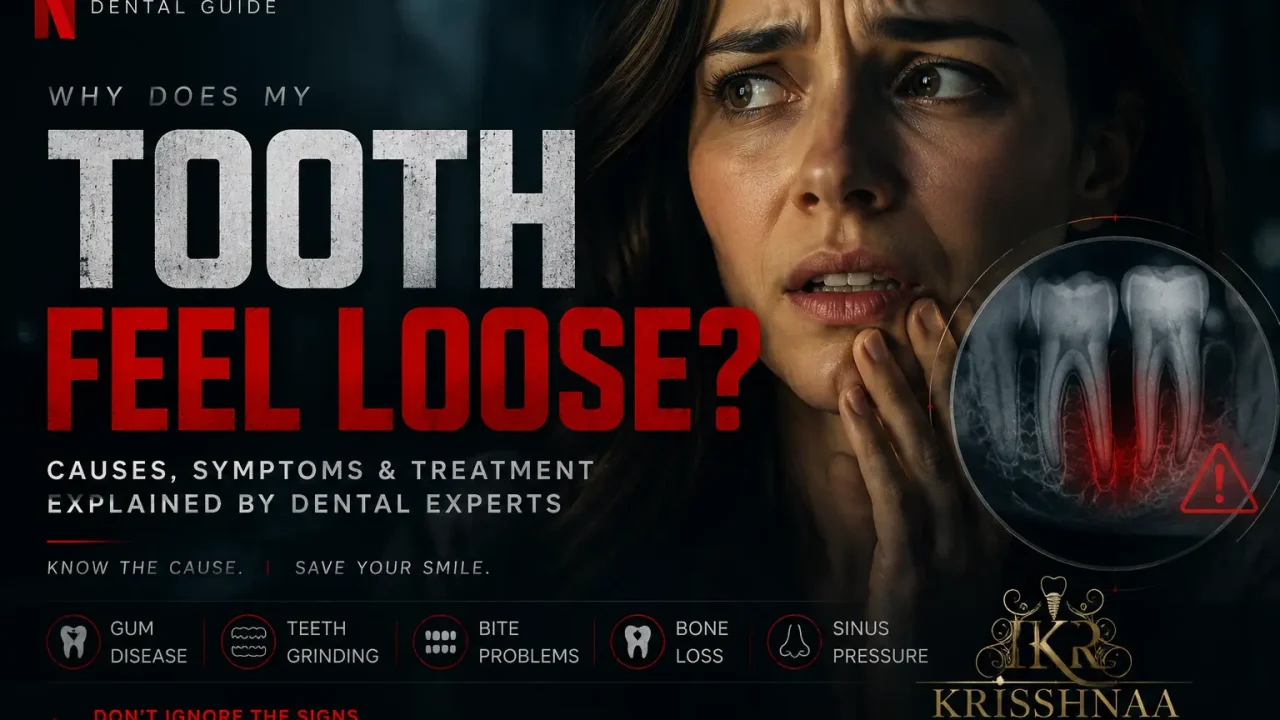
Have you ever pushed your tongue against a tooth and felt it move slightly? Your heart skips a beat. You immediately wonder, “Am I going to lose my tooth?”
The good news is that a tooth feeling loose does not always mean it is about to fall out.
In many cases, the cause is temporary and completely treatable. It could be gum inflammation, teeth grinding, bite problems, or even pressure from a sinus infection. The earlier the cause is identified, the easier it is to save the tooth.
At Krisshnaa Dental & Multispeciality Care, our dentists regularly treat patients who notice tooth mobility before it becomes a serious problem. If you are searching for the best dentist in Central Delhi, dental clinic in Karol Bagh, or tooth mobility treatment in Delhi, this guide explains everything you need to know.
Table of Contents
- Why Does a Tooth Feel Loose?
- Is Slight Tooth Movement Normal?
- Common Causes of Loose Teeth in Adults
- Gum Disease is the Leading Cause
- Teeth Grinding Can Loosen Teeth
- Bite Problems and Uneven Chewing Pressure
- Loose Tooth After Root Canal or Crown
- Loose Tooth After Braces
- Pregnancy and Loose Teeth
- Injury or Trauma
- Bone Loss Around Teeth
- Sinus Infection and Upper Teeth
- Warning Signs You Should Never Ignore
- How Dentists Diagnose a Loose Tooth
- Treatment Options
- Can a Loose Tooth Become Firm Again?
- How to Prevent Tooth Mobility
- Frequently Asked Questions
- Book Your Dental Consultation
Why Does a Tooth Feel Loose?
Your teeth are not fused directly to your jawbone.
Each tooth is attached by tiny elastic fibers known as the periodontal ligament. These fibers act like shock absorbers and allow microscopic movement while chewing.
A healthy tooth naturally moves very slightly.
When these supporting tissues become inflamed or damaged, that tiny movement becomes noticeable.
That is when patients begin saying,
“My tooth feels loose.”
Is Slight Tooth Movement Normal?
Yes.
Healthy teeth have a very small amount of natural movement.
You usually cannot see it.
You may only notice it if
- you press repeatedly with your tongue
- you recently had dental treatment
- your gums are inflamed
- you grind your teeth at night
Excessive movement, however, should always be evaluated by a dentist.
Common Causes of Loose Teeth in Adults
Several conditions can cause tooth mobility.
The most common include:
- Gum disease
- Teeth grinding
- Bone loss
- Bite imbalance
- Trauma
- Orthodontic treatment
- Pregnancy hormones
- Dental infection
- Sinus pressure
Finding the real cause is the key to saving the tooth.
Gum Disease is the Most Common Cause
Periodontal disease is the leading cause of loose teeth in adults.
Plaque and bacteria collect around the gums.
Over time they cause
- gum inflammation
- deep periodontal pockets
- destruction of supporting bone
- weakening of periodontal ligaments
Many patients have no pain at all during the early stages.
Common signs include
- bleeding while brushing
- swollen gums
- persistent bad breath
- gum recession
- loose teeth
Early gum treatment can often stop the disease before permanent damage occurs.
Teeth Grinding Can Make Teeth Feel Loose
Many people grind or clench their teeth while sleeping without realizing it.
This places tremendous pressure on the ligaments surrounding the teeth.
Symptoms include
- morning jaw pain
- headaches
- worn teeth
- sensitive teeth
- feeling that one tooth moves more than others
A custom night guard helps protect the teeth and allows the supporting tissues to recover.
Bite Problems Can Create Tooth Mobility
Sometimes only one tooth feels loose.
The reason may simply be that it is taking excessive biting force.
This commonly happens after
- a new filling
- a dental crown
- bridge placement
- chipped tooth
- uneven bite
A simple bite adjustment often provides immediate relief.
Loose Tooth After Root Canal or Crown
Some patients notice mild movement after dental treatment.
This may happen because
- surrounding ligaments are inflamed
- infection was present before treatment
- bite needs adjustment
The tooth itself is usually not failing.
Your dentist should examine the bite and healing process.
Loose Tooth After Braces
Orthodontic treatment works by gently moving teeth through bone.
During treatment it is normal for teeth to feel slightly mobile.
After braces
- retainers stabilize the teeth
- surrounding bone remodels
- ligaments tighten again
Not wearing retainers can allow unwanted tooth movement.
Pregnancy Can Affect Tooth Stability
Pregnancy hormones relax ligaments throughout the body.
This includes the tissues supporting teeth.
Women may notice
- swollen gums
- bleeding gums
- slight tooth movement
These changes are usually temporary but should still be evaluated by a dentist to rule out gum disease.
Dental Injury Can Loosen a Tooth
Even a minor accident can damage the supporting ligament.
Examples include
- sports injuries
- accidental falls
- biting very hard foods
- road accidents
The tooth may survive if treated quickly.
Never ignore a tooth that becomes loose after trauma.
Bone Loss Around Teeth
As gum disease progresses, supporting bone begins disappearing.
Unfortunately, bone loss is usually painless.
Symptoms include
- teeth shifting
- gaps appearing
- longer-looking teeth
- loose teeth
- difficulty chewing
Digital dental X-rays help measure the amount of bone remaining.
Sinus Infection Can Make Upper Teeth Feel Loose
Upper molars sit very close to the maxillary sinus.
When the sinus becomes inflamed
- pressure develops around tooth roots
- chewing feels uncomfortable
- teeth may seem loose
Once the sinus infection resolves, the sensation usually disappears.
Warning Signs You Should Never Ignore
Book a dental examination immediately if you notice
- increasing tooth movement
- bleeding gums
- pus around the tooth
- severe pain while chewing
- gum recession
- foul taste in the mouth
- swelling
- loose dental crown
- shifting teeth
Early treatment saves teeth.
Delaying treatment often increases treatment cost and complexity.
How Dentists Diagnose a Loose Tooth
At Krisshnaa Dental & Multispeciality Care, we perform a complete evaluation that includes
Clinical Examination
We check
- tooth mobility
- gum health
- bite alignment
- surrounding tissues
Digital Dental X-rays
These help detect
- bone loss
- infection
- hidden fractures
- root problems
Periodontal Examination
We measure gum pocket depth around every tooth.
This helps identify early periodontal disease.
Treatment Depends on the Cause
If Gum Disease is Responsible
Treatment may include
- professional scaling
- root planing
- laser gum therapy
- periodontal maintenance
- improved oral hygiene
If Teeth Grinding is the Cause
Treatment may include
- custom night guard
- bite correction
- stress management
- muscle relaxation advice
If Bite Problems are Present
Treatment includes
- bite adjustment
- polishing high points
- crown adjustment
- replacement of poorly fitting restorations if necessary
If Bone Loss Has Occurred
Treatment options may include
- periodontal therapy
- bone grafting
- guided tissue regeneration
- splinting mobile teeth
Early intervention offers the best chance of saving natural teeth.
If Infection is Present
Treatment depends on the diagnosis.
This may include
- root canal treatment
- drainage of infection
- antibiotics when indicated
- extraction only if the tooth cannot be saved
Our goal is always to preserve your natural tooth whenever possible.
Can a Loose Tooth Become Firm Again?
Yes.
Many loose teeth become stable after proper treatment.
This depends on
- how early treatment begins
- amount of bone loss
- overall gum health
- oral hygiene
The sooner you seek treatment, the better the chances of saving your tooth.
How to Prevent Loose Teeth
Simple habits protect your teeth for years.
- Brush twice daily with fluoride toothpaste.
- Clean between teeth every day.
- Visit your dentist every six months.
- Wear a night guard if you grind your teeth.
- Do not ignore bleeding gums.
- Avoid smoking and tobacco products.
- Eat a balanced diet rich in calcium and vitamin D.
- Treat dental problems before they become severe.
Frequently Asked Questions
Can a loose tooth tighten naturally?
If the cause is temporary inflammation or teeth grinding, it often becomes firm again after treatment. Teeth with severe bone loss require professional care.
Can stress make teeth feel loose?
Yes. Stress often causes unconscious teeth grinding and clenching, which overloads the supporting ligaments.
Is a loose tooth always caused by gum disease?
No. Bite problems, trauma, orthodontic treatment, pregnancy, infections and sinus pressure can also cause tooth mobility.
Should I pull out a loose tooth?
No.
Never attempt to remove a loose permanent tooth yourself.
Many teeth that seem loose can still be successfully saved.
Is treatment painful?
Modern dental treatment is performed using local anesthesia and advanced techniques that make procedures comfortable for most patients.
Why Early Treatment Matters
A loose tooth is your body’s way of telling you something needs attention.
Sometimes the solution is as simple as adjusting your bite.
Sometimes it requires treating gum disease before permanent bone loss occurs.
Ignoring the problem rarely makes it better.
At Krisshnaa Dental & Multispeciality Care, our experienced dentists use digital diagnostics and evidence-based treatment to identify the exact cause of tooth mobility and help patients save their natural teeth whenever possible.
Whether you have noticed slight movement, bleeding gums, pain while chewing, or shifting teeth, early treatment can make all the difference.
Book Your Dental Consultation Today
If your tooth feels loose, do not wait until it becomes painful or falls out.
Visit Krisshnaa Dental & Multispeciality Care, one of the trusted dental clinics in Karol Bagh, Central Delhi, for a comprehensive dental examination.
Our team offers personalized treatment for gum disease, loose teeth, dental infections, bite problems, and advanced periodontal care using modern technology.
Call: +91 7836983698 | +91 7836983625
Website: www.krisshnaadental.com