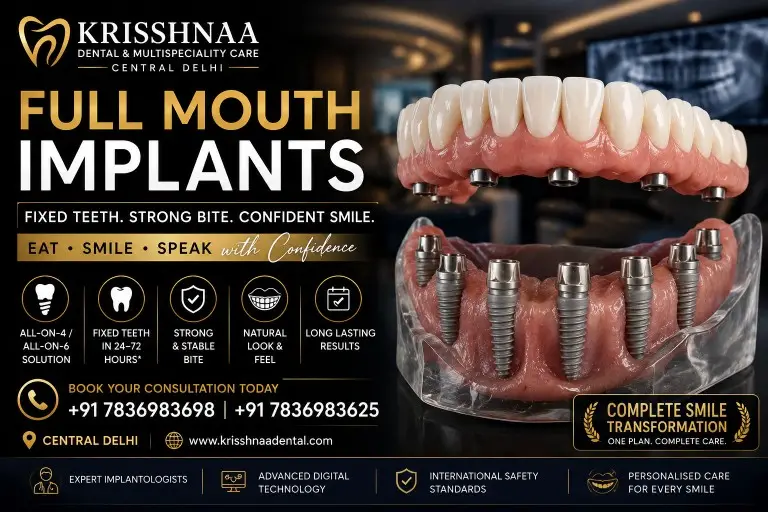
If you have lost most or all of your teeth, you may have come across two popular full-mouth implant options: All-on-4 dental implants and All-on-6 dental implants.
For NRI patients considering dental treatment in India, the choice can be difficult. You may be comparing treatment time, implant quality, cost, recovery, travel requirements and, most importantly, how well the new teeth will function for many years.
The important point is that All-on-4 is not automatically better than All-on-6, and All-on-6 is not automatically better for every patient.
The right treatment depends on your available bone, bite forces, gum health, medical history, aesthetic expectations, prosthetic requirements and long-term maintenance.
At Krisshnaa Dental & Multispeciality Care, Central Delhi, full-mouth implant treatment is planned around the individual patient rather than simply choosing a fixed number of implants.
If you are an NRI planning full mouth dental implants in India, here are seven questions worth discussing with your implant dentist before booking your treatment.
1. What Is the Difference Between All-on-4 and All-on-6?
The simplest difference is the number of implants used to support a fixed full-arch prosthesis.
All-on-4 dental implants generally use four strategically positioned implants to support a fixed set of teeth.
All-on-6 dental implants use six implants to support the full arch.
The difference is not simply “four versus six.” Implant position, bone quality, implant size, prosthetic design, bite forces and the condition of the remaining jawbone all influence the final treatment plan.
In suitable patients, both approaches can provide fixed teeth with good function and aesthetics.
Quick comparison
| Feature | All-on-4 | All-on-6 |
|---|---|---|
| Number of implants | Usually 4 | Usually 6 |
| Full-arch fixed teeth | Yes | Yes |
| Bone requirements | May work well in selected patients with reduced bone | May provide additional support where adequate bone is available |
| Surgical approach | Often less extensive | Requires additional implant sites |
| Load distribution | Distributed across 4 implants | Distributed across 6 implants |
| Treatment cost | Usually lower | Usually higher |
| Best choice | Depends on individual anatomy | Depends on individual anatomy |
The implant count should therefore be decided after a proper clinical and 3D assessment, not simply by choosing the option with more implants.
2. Is All-on-6 Better Than All-on-4?
This is one of the most common questions asked by NRI patients.
The answer is: not necessarily.
Six implants can provide additional support and may improve load distribution in appropriate cases. However, using more implants does not automatically mean a better outcome.
All-on-4 may be an excellent option for carefully selected patients, particularly when available bone is limited in certain areas or when a treatment plan is designed to avoid more extensive bone augmentation.
All-on-6 may be considered when the patient’s anatomy and bone availability allow placement of additional implants and when the clinical team believes the extra support is beneficial.
Your dentist should assess:
- Jawbone volume and density
- Implant positions
- Bite and chewing forces
- Gum condition
- Previous dental treatment
- Sinus anatomy where relevant
- Smoking and oral hygiene habits
- Prosthetic requirements
- Overall health
- Long-term maintenance
The goal is not to place the maximum number of implants. The goal is to create a stable, maintainable and functional full-arch restoration.
3. Can All-on-4 Work If I Have Lost Bone?
In many cases, yes, but this depends on the amount and location of bone loss.
Patients who have worn dentures for years may have experienced significant jawbone resorption. Traditional implant placement may then require additional procedures such as bone grafting or sinus augmentation.
In selected cases, an All-on-4 approach can use strategically positioned implants to take advantage of available bone and reduce the need for extensive augmentation.
However, this should never be assumed before examining the patient.
A CBCT 3D scan is often important for evaluating:
- Available bone
- Nerve position
- Sinus anatomy
- Implant positioning
- Bone defects
- Potential need for grafting
- Prosthetic space
For NRI patients, preliminary records and scans can also help the dental team assess the case before travel and discuss the likely treatment pathway during a virtual consultation.
4. Which Option Looks More Natural?
Both All-on-4 and All-on-6 can produce highly natural-looking teeth.
The final appearance is influenced by much more than the number of implants.
Important factors include:
- Tooth shape
- Tooth colour
- Gum and lip support
- Smile line
- Facial proportions
- Tooth position
- Prosthetic material
- Bite arrangement
- Digital planning
- The experience of the restorative and implant team
A full-mouth rehabilitation should be designed around the patient’s face and smile rather than using a standard tooth arrangement.
For patients travelling from overseas, discussing the expected aesthetic result before treatment is particularly important.
You should understand what type of temporary and final teeth are planned, what materials may be used and how many visits are expected.
5. How Long Does All-on-4 or All-on-6 Treatment Take in India?
Treatment time varies significantly from patient to patient.
Some patients may be suitable for an immediate loading approach, where a temporary fixed prosthesis is provided soon after implant placement.
Other patients may require healing before receiving their definitive prosthesis.
Your treatment timeline can depend on:
- Bone quality
- Need for extraction
- Infection
- Bone grafting
- Sinus lift
- Implant stability
- Gum condition
- Medical history
- Type of final prosthesis
- Laboratory requirements
What should NRI patients plan for?
Before travelling to India, ask your dental team for a written treatment schedule.
It should ideally explain:
- What happens during the first visit
- Whether teeth need to be removed
- Whether implants can be placed immediately
- Whether temporary fixed teeth are possible
- How long you need to remain in India
- When the final prosthesis will be fitted
- Whether a second visit is required
- What follow-up care will be needed after returning home
This can make planning your flights, accommodation and time away from work much easier.
6. How Much Do All-on-4 and All-on-6 Dental Implants Cost in India?
The cost of full-mouth dental implants varies because every case is different.
The final estimate may depend on:
- Number and brand of implants
- Implant system used
- Temporary teeth
- Final prosthetic material
- Extractions
- Bone grafting
- Sinus lift
- Digital scans
- Laboratory charges
- Sedation or anaesthesia requirements
- Additional restorative treatment
In general, All-on-6 may cost more than All-on-4 because it involves additional implants and associated components.
However, comparing treatment purely on price can be misleading.
An NRI patient should ask for a complete treatment quotation that clearly explains what is included.
Before comparing dental implant costs in India, ask:
- Are the implants included?
- Is the temporary fixed prosthesis included?
- Is the final prosthesis included?
- Are extractions included?
- Is bone grafting included if required?
- Are scans included?
- What implant brand is being used?
- How many visits are expected?
- What happens if additional treatment is required?
A transparent treatment plan makes it easier to compare clinics in India and overseas.
7. Which Is Better for an NRI Patient: All-on-4 or All-on-6?
There is no universal answer.
For one patient, All-on-4 may provide an efficient and well-planned solution.
For another patient, All-on-6 may provide the additional support that the clinical situation requires.
The decision should be based on your individual anatomy, functional requirements and long-term treatment goals.
For NRI patients, there is another important consideration: planning before you travel.
A good pre-arrival consultation should help you understand:
- Your likely treatment options
- Required diagnostic records
- Expected number of visits
- Approximate treatment timeline
- Possible additional procedures
- Temporary and final teeth
- Estimated treatment cost
- Follow-up arrangements
This can help avoid unnecessary surprises after arriving in India.
All-on-4 vs All-on-6: Which One Should You Choose?
Instead of asking:
“Which is the best, All-on-4 or All-on-6?”
Ask:
“Which full-arch implant solution is appropriate for my jaw and my long-term needs?”
That is the more useful question.
Your implant dentist should evaluate the complete situation before recommending the number and position of implants.
At Krisshnaa Dental & Multispeciality Care in Central Delhi, patients considering dental implants can discuss their treatment requirements with the dental team and explore options for full-mouth rehabilitation.
For NRI patients, preliminary consultation and treatment planning can be particularly useful before travelling to India.
Why NRI Patients Consider Dental Implants in India
India has become a destination for patients seeking complex dental treatment because treatment can often be combined with planned travel and longer-term dental care.
However, choosing a dental implant clinic should not be based on price alone.
For full-mouth implant treatment, look for:
- Experienced implant clinicians
- Proper diagnostic imaging
- Digital treatment planning
- Clear implant and prosthesis details
- Sterilisation and infection-control protocols
- Transparent quotations
- Written treatment timelines
- A plan for maintenance
- Clear communication before and after treatment
Full-mouth implants are a major investment in your oral health. The quality of planning matters as much as the implant procedure itself.
Planning Full-Mouth Dental Implants From Overseas?
If you are an NRI living in the UK, USA, Canada, Australia, UAE, Singapore or another country, you do not necessarily need to wait until you arrive in India to start discussing your treatment.
You can begin with a remote consultation and share your previous dental records and available scans.
The dental team can then advise what additional diagnostic information may be required before confirming the treatment plan.
For patients travelling to Delhi, planning in advance can help coordinate:
- Consultation
- CBCT scan
- Implant surgery
- Temporary teeth
- Healing and review
- Final prosthesis
- Follow-up
Ready to Discuss Your Full-Mouth Implant Options?
If you are considering All-on-4, All-on-6 or full-mouth dental implants in Delhi, speak with the team at Krisshnaa Dental & Multispeciality Care, Central Delhi about your individual case.
You can share your existing dental records and discuss whether an online preliminary consultation is suitable before travelling to India.
Call: +91 7836983698 or +91 7836983625
Website: www.krisshnaadental.com
Frequently Asked Questions About All-on-4 and All-on-6
What is All-on-4 dental implant treatment?
All-on-4 is a full-arch implant treatment concept in which a fixed prosthesis is supported by four strategically positioned dental implants in a suitable patient.
What is All-on-6 dental implant treatment?
All-on-6 uses six dental implants to support a fixed full-arch prosthesis when the patient’s anatomy and treatment plan make this approach appropriate.
Is All-on-6 stronger than All-on-4?
All-on-6 can provide additional implant support and load distribution, but it is not automatically the better treatment. The appropriate option depends on bone anatomy, bite forces, prosthetic requirements and other clinical factors.
Can I get fixed teeth on the same day?
Some carefully selected patients may be candidates for immediate loading and temporary fixed teeth. This depends on implant stability, bone condition, infection and the overall treatment plan.
How long do All-on-4 implants last?
Dental implants can function for many years when properly planned, placed and maintained. Longevity depends on factors including oral hygiene, gum health, bite forces, smoking, general health and regular professional maintenance.
How long do All-on-6 implants last?
All-on-6 restorations can also provide long-term function when appropriately planned and maintained. The number of implants alone does not determine how long the treatment will last.
Is All-on-4 suitable for patients with bone loss?
It may be suitable for selected patients with reduced bone availability, but a CBCT scan and clinical assessment are necessary to determine whether the approach is appropriate.
Can NRI patients plan dental implants before travelling to India?
Yes. Preliminary online consultations can help NRI patients understand the likely treatment pathway and identify the diagnostic records or scans required before travelling.
How many trips to India are required for full-mouth implants?
The number of visits depends on the treatment protocol, healing requirements, prosthesis and whether additional procedures such as bone grafting are needed. Your dentist should provide a proposed timeline before you travel.
Is dental implant treatment in Delhi suitable for NRI patients?
Delhi has dental clinics offering implant and full-mouth rehabilitation services. NRI patients should compare clinicians, diagnostics, implant systems, prosthetic options, treatment timelines, follow-up arrangements and total costs before choosing a clinic.
Final Takeaway
All-on-4 and All-on-6 can both be effective full-mouth dental implant solutions. The right choice is not determined simply by whether four or six implants sound better.
Your bone condition, bite, gum health, prosthetic needs, aesthetics, treatment timeline and long-term maintenance requirements all matter.
For NRI patients, the best time to start planning is before you book your flight.
A proper consultation can help you understand what treatment may be required, how long you may need to stay in India and what questions you should ask before committing to full-mouth dental implants.
If you are researching All-on-4 vs All-on-6 dental implants in India, or considering full-mouth dental implants in Delhi, contact Krisshnaa Dental & Multispeciality Care, Central Delhi to discuss your case.
Call +91 7836983698 or +91 7836983625